


Why Won’t My Hair Grow Past Shoulders? The Hormonal Truth Behind the Plateau
You’ve been taking the vitamins. You’ve stopped using heat. You’ve even switched to silk pillowcases. But your hair? It’s been hovering at shoulder length for months—maybe years—refusing to budge past that invisible line at your collarbones.
If this sounds familiar, you’re not imagining things. The “shoulder-length plateau” is a real phenomenon, and for women in their late 30s to 50s, it’s rarely about damaged ends or lack of biotin. It’s hormonal.
3 Short Answers: Why Won’t My Hair Grow Past Shoulders?
- Cortisol is the main culprit: Chronic stress releases cortisol, which prematurely pushes hair follicles out of the growth phase, creating a “ceiling” around shoulder length for many women.
- Thyroid slows everything down: An underactive thyroid reduces metabolic fuel to follicles, making hair growth sluggish and causing strands to reach terminal length earlier than they should.
- Estrogen dominance stalls growth: High estrogen relative to progesterone can thicken individual hairs but actually shortens the growth cycle, preventing length accumulation beyond the shoulders.
The Invisible Ceiling: What “Terminal Length” Really Means

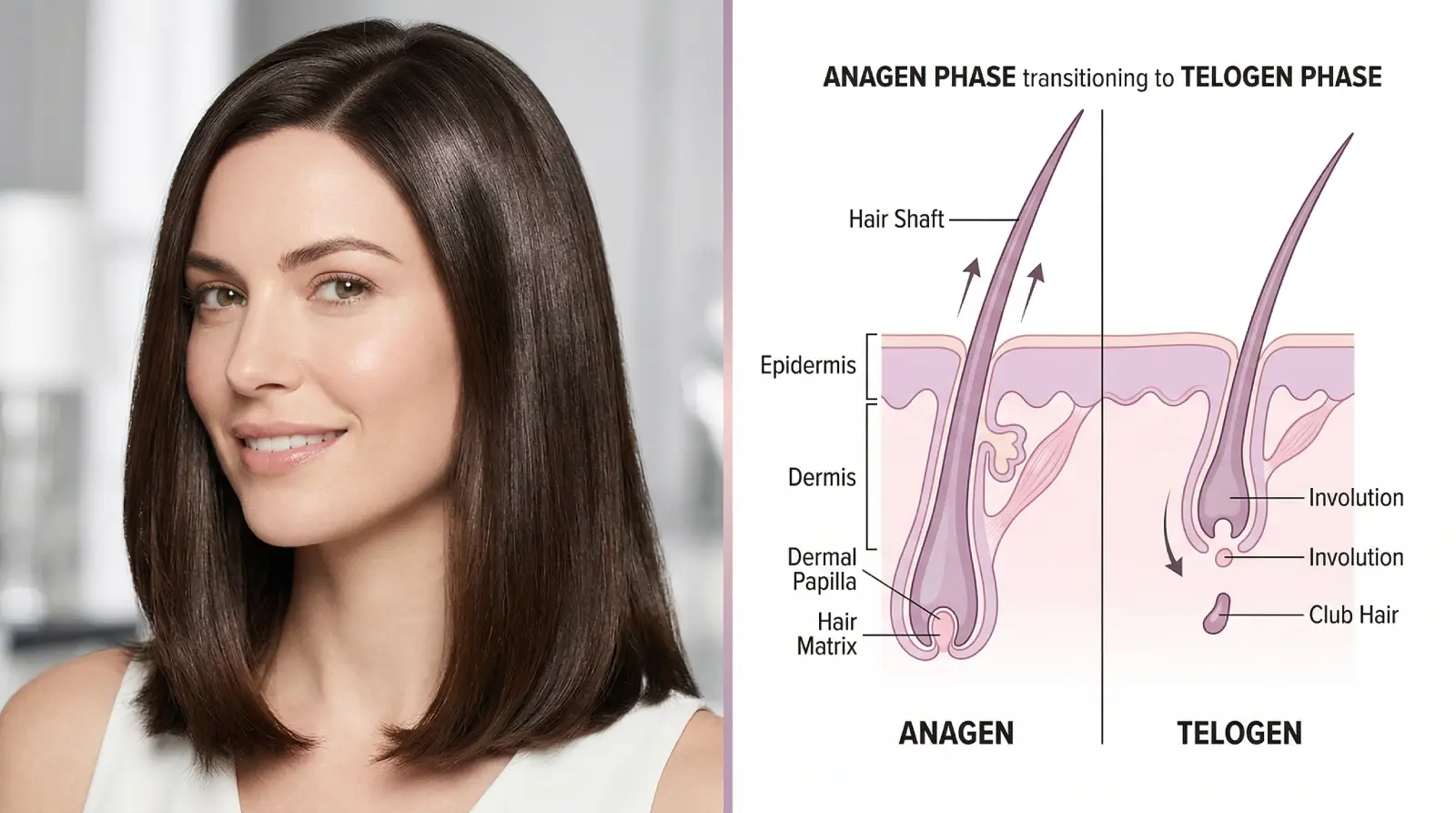
Your hair has a natural growth cycle with three phases: anagen (growing), catagen (transition), and telogen (resting/shedding). The anagen phase determines your maximum potential length—this is your “terminal length.”
For most people, anagen lasts 2-7 years. If yours is shortening to 2-3 years due to hormonal shifts, your hair simply runs out of growth time before it can reach your waist. It sheds at shoulder length, restarts, and repeats the cycle—creating the illusion that your hair “won’t grow.”
What this means: Your hair is growing. It’s just not staying in the growth phase long enough to accumulate length. The follicle is receiving signals to stop building the hair shaft and start over.
6 Hormonal Reasons Why Your Hair Won’t Grow Past Shoulders
1. Cortisol — The Stress Hormone That Sets the Ceiling
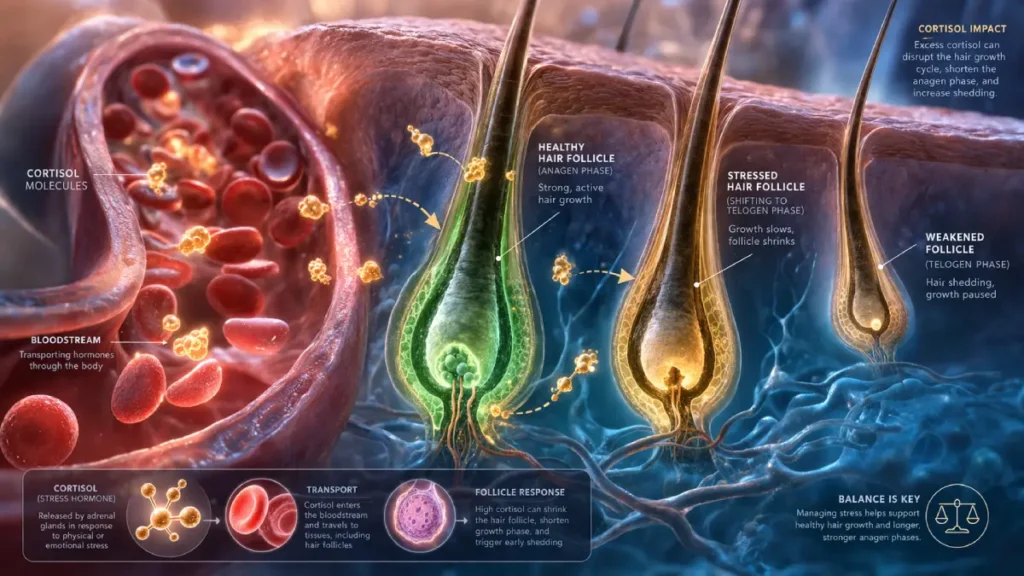
When life runs at full volume — deadlines, poor sleep, grief, illness, caregiving — your adrenal glands flood your system with cortisol. High cortisol does two damaging things: it constricts blood flow to follicles (starving them of nutrients) and prematurely signals shedding, cutting the anagen phase shorter than biology intended.
If your hair stopped growing past shoulders during or after a high-stress period, cortisol almost certainly set that ceiling.
2. Thyroid Imbalance — When the Metabolism Slows Your Strands
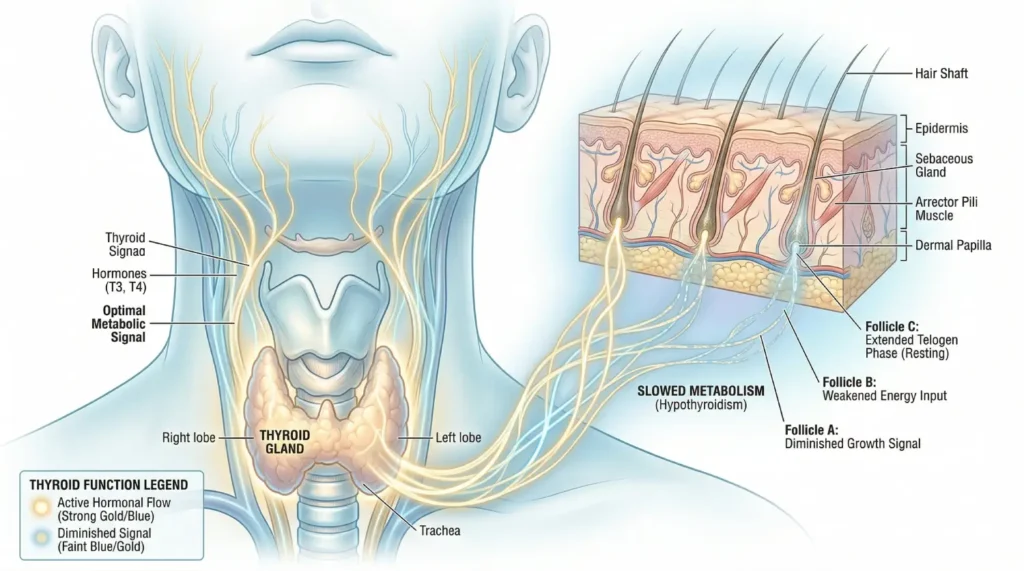
Your thyroid governs how efficiently cells produce and use energy. When it’s underactive (hypothyroidism), cellular metabolism slows across the board — including the rapid cell division that builds your hair shaft. Hair becomes brittle, dry, and reaches terminal length earlier because the follicle’s energy supply is perpetually low.
You may have years of anagen time left on the biological clock — but if your thyroid is sluggish, the follicle can’t build fast enough to use it. The shoulder becomes the stopping point.
3. Estrogen Dominance — Full Roots, Frozen Length

High estrogen relative to progesterone — common in perimenopause and with certain hormonal birth controls — creates a confusing paradox. Some follicles linger in growth longer, producing thick, dense strands at the root. Others are pushed into early shedding. The overall result: hair that feels lush and healthy but stops accumulating length at the shoulders, reliably, every cycle.
The misconception this corrects: Thick hair is not the same as long hair. Estrogen can increase strand diameter while shrinking the growth window — which is exactly why so many women with full, healthy-looking hair still ask why won’t my hair grow past shoulders
4. Insulin Resistance — Blood Sugar and Follicle Starvation
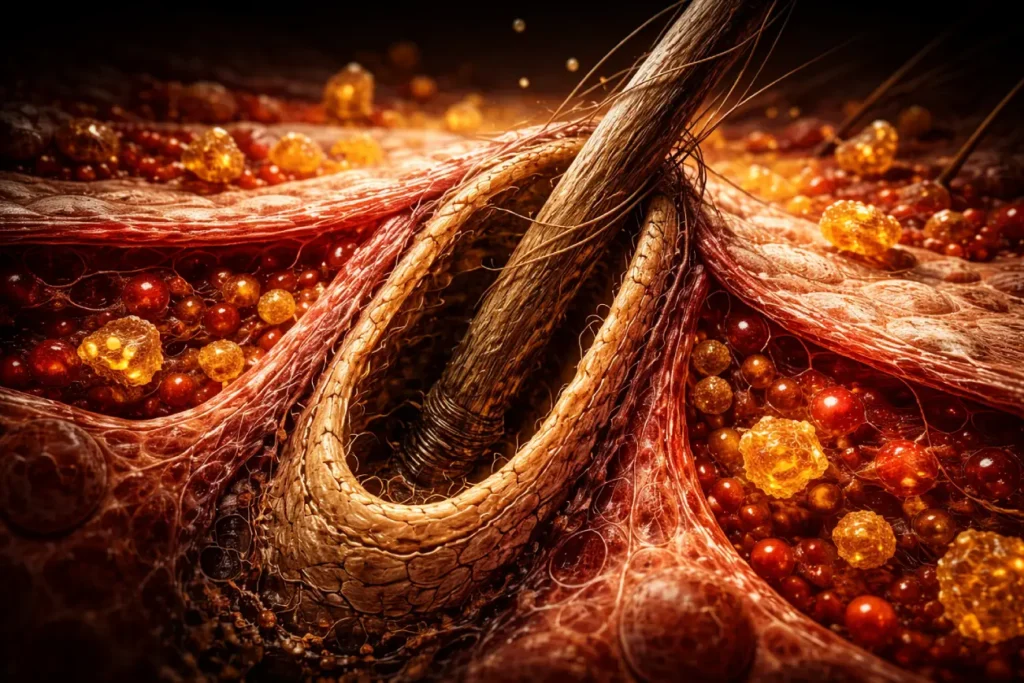
Elevated insulin triggers chronic low-grade inflammation and reduces circulation to peripheral tissue — including the scalp. Follicles become metabolically starved, unable to absorb the glucose they need for building a strand. High-glycemic diets compound this, spiking insulin repeatedly and disrupting follicle function from the inside out.
5. Declining Progesterone and DHT — The Double Signal to Stop

Progesterone naturally blocks the enzyme that converts testosterone into DHT — the androgen that miniaturizes follicles and shortens growth cycles. After 35, progesterone levels drop and DHT sensitivity rises. The protection disappears. Follicles produce shorter anagen phases, and hair reliably stalls at shoulder length before shedding.
6. Declining Growth Hormone — Age and the Anagen Cliff
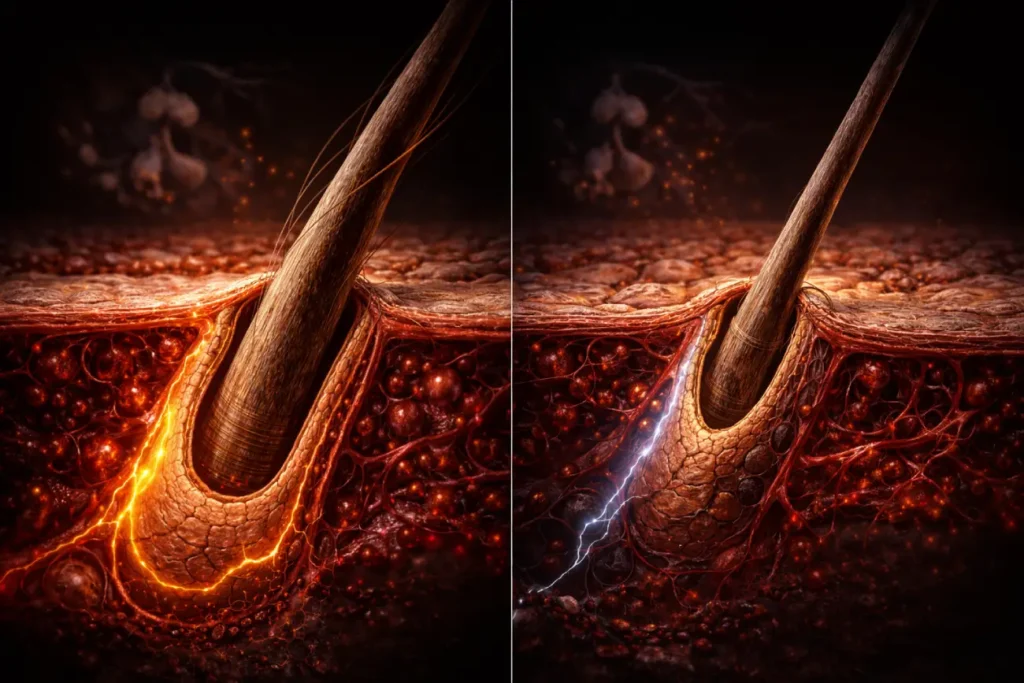
Growth hormone (GH) drops steadily with age and drives IGF-1, the growth factor that powers follicle activity. Lower GH means shorter anagen phases — which is why the question why won’t my hair grow past shoulders becomes far more common after 40, even in women who once grew long hair with ease.
Mechanical vs. Hormonal: Which Problem Do You Actually Have?
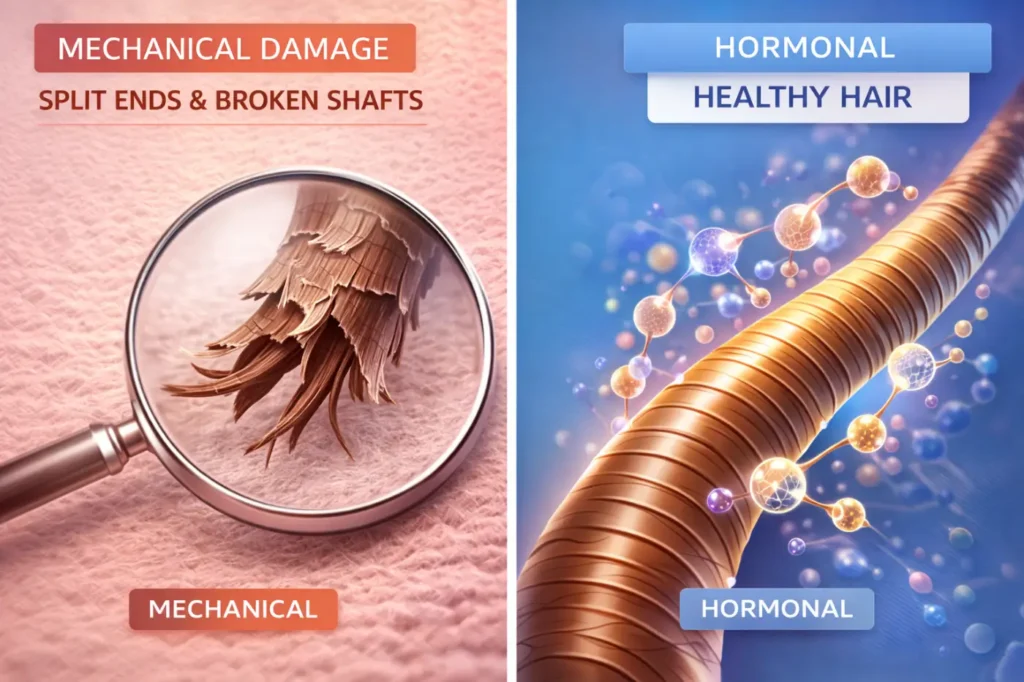
If your ends are split, see-through, or breaking off, you have mechanical damage. Trim and protect.
But if your ends look healthy—no splits, consistent thickness from root to tip—but you haven’t seen new length in 6+ months despite protective styling, you’re dealing with a hormonal growth ceiling.
Comparison:
- Mechanical: Visible damage, tapering ends, breakage sounds when combing dry hair
- Hormonal: Healthy ends, density at roots, growth simply “stops” at the same length repeatedly
When to Consider Testing (And What to Ask For)

If the hormonal description fits, consider asking your doctor for:
- AM Cortisol: Measures stress hormone baseline (should be drawn between 7-9 AM)
- TSH, Free T3, Free T4: Full thyroid panel, not just TSH
- Estrogen/Progesterone Ratio: Best tested days 19-21 of your cycle if cycling; anytime if post-menopausal
- Fasting Insulin: More sensitive than glucose for detecting resistance
- DHEA-S: Adrenal health marker
The bottom line: Your shoulder-length plateau isn’t a failure of willpower or hair care. It’s biological signaling. Once you identify which hormone is hitting the brakes, you can address the root cause—and finally let your hair reach its real potential.
FAQ
Can stress really stop my hair from growing past my shoulders?
Yes. Chronic stress elevates cortisol, which shortens the active growth phase. When cortisol stays elevated for months, it prematurely pushes hair follicles into the shedding phase. If your hair normally grows for 4 years but stress cuts that to 2 years, you hit terminal length at shoulder instead of mid-back.
How do I know if it's my thyroid or just aging?
Thyroid-related hair issues usually come with other symptoms like cold intolerance, fatigue, or dry skin. While aging slows growth gradually, thyroid issues create a sudden stall. Get TSH and free T3/T4 tested if you notice hair changes alongside energy or temperature regulation issues.
Will taking biotin break through the shoulder-length plateau?
Probably not if the cause is hormonal. Biotin helps if you're deficient, but it doesn't extend the anagen phase or lower cortisol. For hormonal ceilings, you need to address the endocrine imbalance, not just add supplements.
Can birth control cause my hair to stop growing?
Yes, progestin-dominant pills can affect hair growth cycles. Some synthetic progestins have androgenic effects that shorten anagen phases. If your plateau started after beginning hormonal contraception, consult your doctor about low-androgen options.
Is the shoulder-length plateau permanent?
Not necessarily. If mechanical, trim and protect. If hormonal, correcting the imbalance (managing cortisol, optimizing thyroid, balancing estrogen) can restart longer anagen phases, allowing hair to grow beyond previous limits.
Why does my hair grow to my shoulders then shed like crazy?
You may have telogen effluvium triggered by stress or hormonal shifts. This condition pushes multiple follicles into the shedding phase simultaneously. It often resolves when the trigger (stress, illness, hormonal shift) is addressed.
Does menopause stop hair from growing long?
It can slow growth and shorten anagen phases. Declining estrogen and progesterone during menopause often result in slower-growing hair that reaches terminal length sooner. However, proper support can maintain length for many women post-menopause.
Can diet really affect how long my hair grows?
Yes, especially insulin-related dietary patterns. High-glycemic diets spike insulin, which can disrupt follicle function. Protein and healthy fats support the cellular energy needed for long anagen phases.
How long does it take to see length after fixing hormones?
3-6 months minimum. Hair grows roughly 0.5 inches per month, and you need new growth to reach shoulder length to see the difference. Hormonal shifts also take 2-3 months to reflect in hair cycles.
Should I get hormone tests if my hair is stuck at shoulders?
Yes, if the plateau persists longer than 6 months without mechanical damage. A basic panel including cortisol, thyroid markers, and sex hormones can reveal hidden imbalances preventing length retention.
Is this different from hair loss?
Yes. You're not losing hair; you're reaching terminal length early. True hair loss involves shedding or thinning. The shoulder-length plateau involves normal density that simply won't accumulate length—a distinction that points directly to anagen phase duration issues.
Can scalp massages help if it's hormonal?
They help circulation but won't fix the underlying hormonal signal. Massage increases blood flow temporarily, but if cortisol or thyroid issues are shortening your growth phase internally, external stimulation has limited impact.