Skip to content

FREE SHIPPING OVER $69

+500,000 SATISFIED CUSTOMERS

sparccle.com

Why Your Skin Feels Dry AND Oily at 38

If your face feels tight in some areas and greasy in others, perimenopause may already be changing your hormones — even if you haven’t noticed any other symptoms yet.

Yes, perimenopause can cause your skin to feel dry and oily at the same time. Falling estrogen weakens your skin barrier and reduces moisture. Meanwhile, androgen and cortisol fluctuations boost oil production in the T-zone — both happening on the same face simultaneously.

During perimenopause, estrogen levels drop unevenly. This reduces collagen and natural moisture retention in your skin. At the same time, androgens and cortisol can spike, triggering excess sebum in oilier zones like your forehead and nose — two separate hormonal processes producing opposite effects at once.

Perimenopause can begin as early as 35–38. Many women notice skin changes — including the dry-oily combination — before they notice anything else, like irregular periods or mood shifts.

Most women associate perimenopause with their mid-40s and missed periods. But skin changes frequently arrive years earlier — before cycles shift at all. That’s why so many women spend months troubleshooting products when the root cause is hormonal.

Zone-based skincare tends to work better than one product applied everywhere. Lighter, sebum-regulating products on the T-zone and barrier-repair ingredients on dry areas is the general approach. Ceramides, niacinamide, and peptides are the most consistently useful categories for this specific skin pattern.

You wash your face in the morning. By noon, your forehead is shiny. But your cheeks feel tight — almost like you forgot to moisturize. You did moisturize. Twice.

If this sounds familiar and you’re somewhere between 35 and 45, this probably isn’t a product problem. It’s a hormone problem. Specifically, it’s likely perimenopause — and it can start changing your skin years before your periods become irregular.

Here’s what’s actually happening.

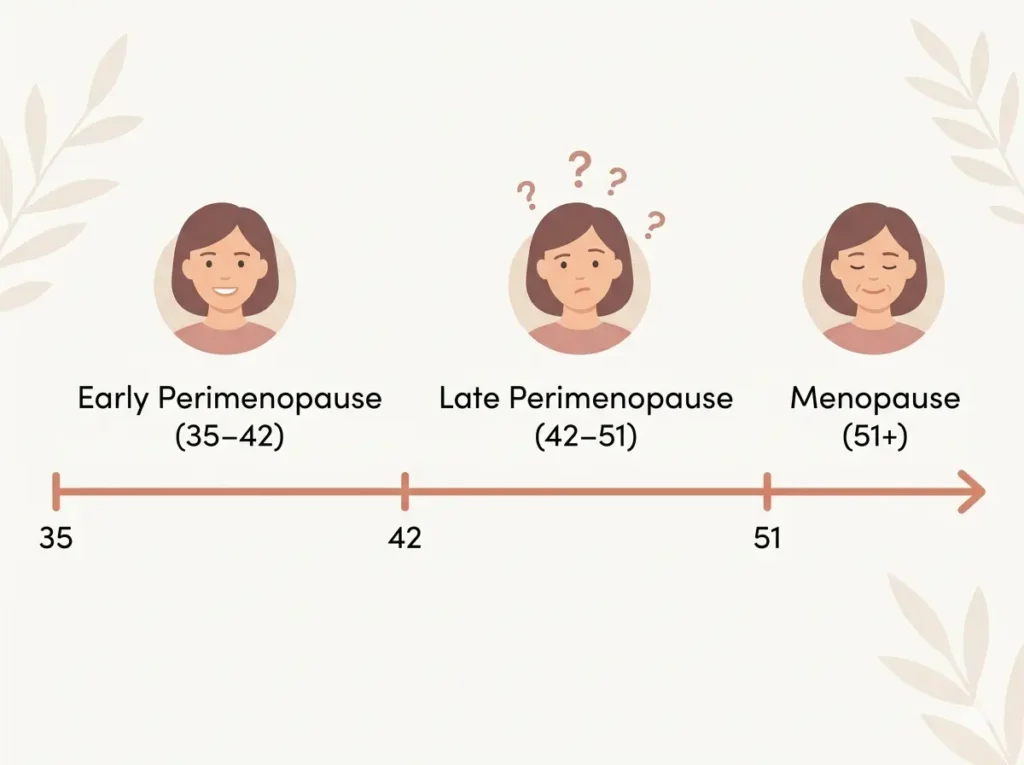
Illustrated timeline of perimenopause stages from age 35 to 52 showing early and late transition phases

Perimenopause is the transition phase leading up to menopause. It’s not menopause itself — it’s the years before, when estrogen and progesterone levels start shifting unpredictably. For most women it begins between 35 and 45, though some notice changes earlier.

During this phase, hormones don’t just drop — they fluctuate. Some days levels are relatively normal. Other days they swing low. That inconsistency is part of what makes the symptoms so confusing.

Your skin is one of the first places these shifts show up because estrogen receptors live in skin tissue. When estrogen levels change, your skin responds fast.

What This Means: You don’t need irregular periods to be in perimenopause. Skin changes often arrive first — sometimes years before anything else feels different.

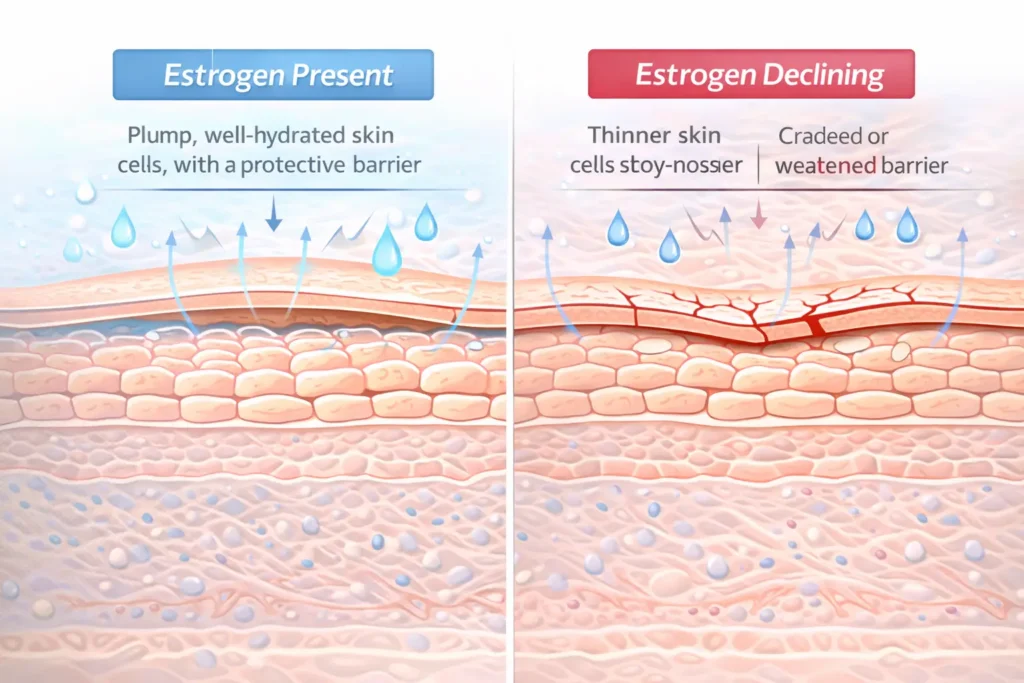
Illustrated cross-section comparing hydrated skin with healthy estrogen versus dry weakened skin with declining estrogen during perimenopause

Estrogen plays a direct role in keeping your skin moist, thick, and elastic. It helps your skin produce hyaluronic acid — the substance that holds water in your skin cells. It also supports collagen production, which keeps your barrier strong.

When estrogen starts dropping during perimenopause, several things happen at once:

  • Hyaluronic acid production slows — your skin holds less water
  • Collagen starts declining — skin becomes thinner and less resilient
  • The skin barrier weakens — moisture escapes faster than it should
  • Cell turnover slows — dead skin accumulates more easily

The result is skin that feels dry, tight, and sometimes almost papery — especially on your cheeks, jawline, and around your eyes.

Short Answer: Estrogen helps your skin hold moisture. When it drops during perimenopause, your skin barrier weakens and moisture escapes faster — causing dryness and tightness, especially on the cheeks and jaw.

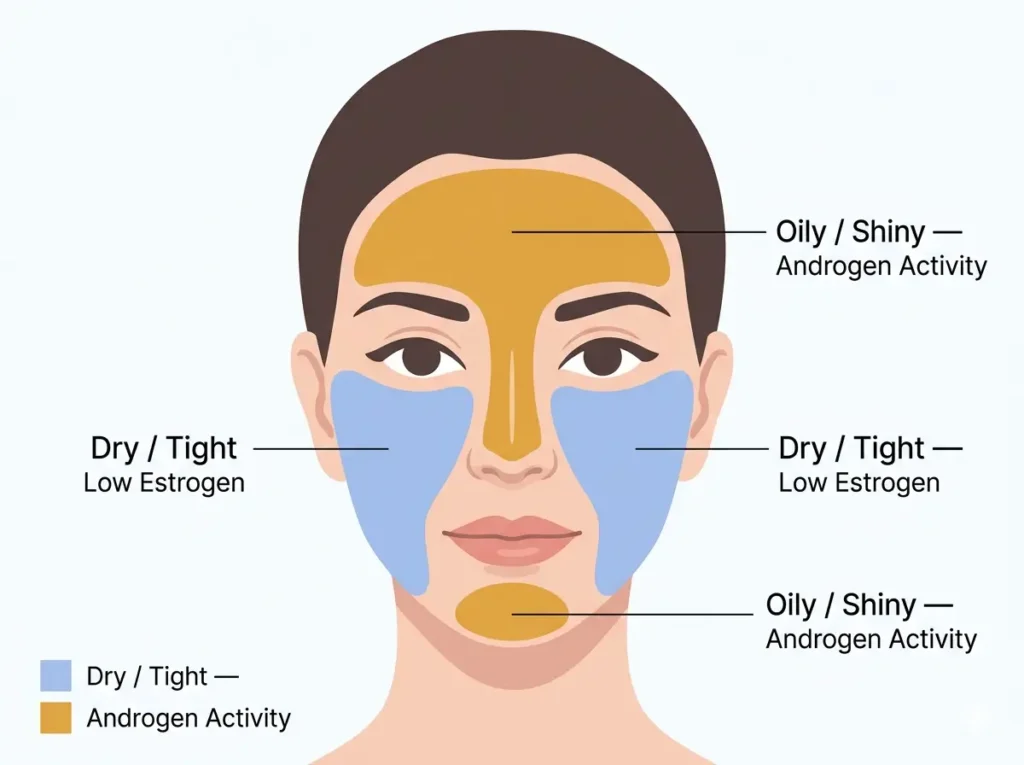
Face zone map illustration showing dry tight cheeks in blue and oily T-zone in amber for perimenopause combination skin

Here’s where it gets confusing. While estrogen is dropping, other hormones are fluctuating too — and some push in the opposite direction.

Androgens are hormones women also produce. During perimenopause, as estrogen drops, androgens become relatively more active by comparison. Androgens stimulate sebaceous glands — the glands that produce oil (sebum).

The T-zone has a higher concentration of sebaceous glands than the rest of your face. So when androgen activity increases, that’s where oil shows up most.

Cortisol — your stress hormone — can also rise during perimenopause due to disrupted sleep and hormonal instability. Cortisol is another known trigger for excess sebum production.

So you end up with:

  • Dry, tight cheeks from low estrogen and a weakened barrier
  • Oily forehead and nose from androgen and cortisol activity

Both happening on the same face. At the same time. That’s not a product failure — that’s two separate hormonal processes running simultaneously.

Short Answer: Androgens stimulate oil glands — especially in the T-zone. During perimenopause, estrogen drops but androgens stay relatively active, which is why your forehead and nose stay oily even when the rest of your face feels dry.

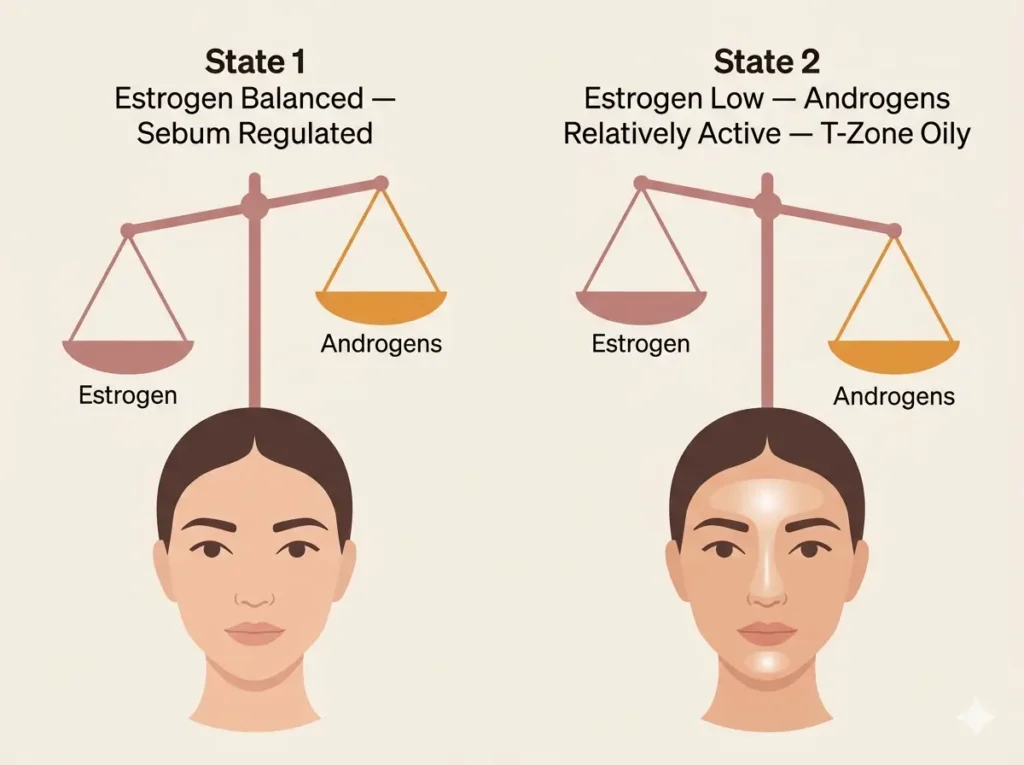
Diagram showing how balanced estrogen regulates sebum production versus how low estrogen allows androgen-driven oiliness during perimenopause

Most skincare marketing treats oily and dry skin as opposite problems needing opposite solutions. But perimenopause skin doesn’t work that way.

Estrogen helps regulate sebum production across the whole face. When estrogen is at healthy levels, oil production stays more balanced. When it drops, that regulation weakens — leaving oil glands more reactive to androgen signals, particularly in the T-zone.

This is why women who never had oily skin in their 20s can develop a greasy T-zone in their late 30s. It’s not a new skin type. It’s a shift in the hormonal system that was quietly keeping everything balanced.

What This Means: Combination skin appearing for the first time in your late 30s is often a hormonal signal — not a permanent change in your skin type. Treating it as a product problem without understanding the hormonal root usually leads straight to frustration.

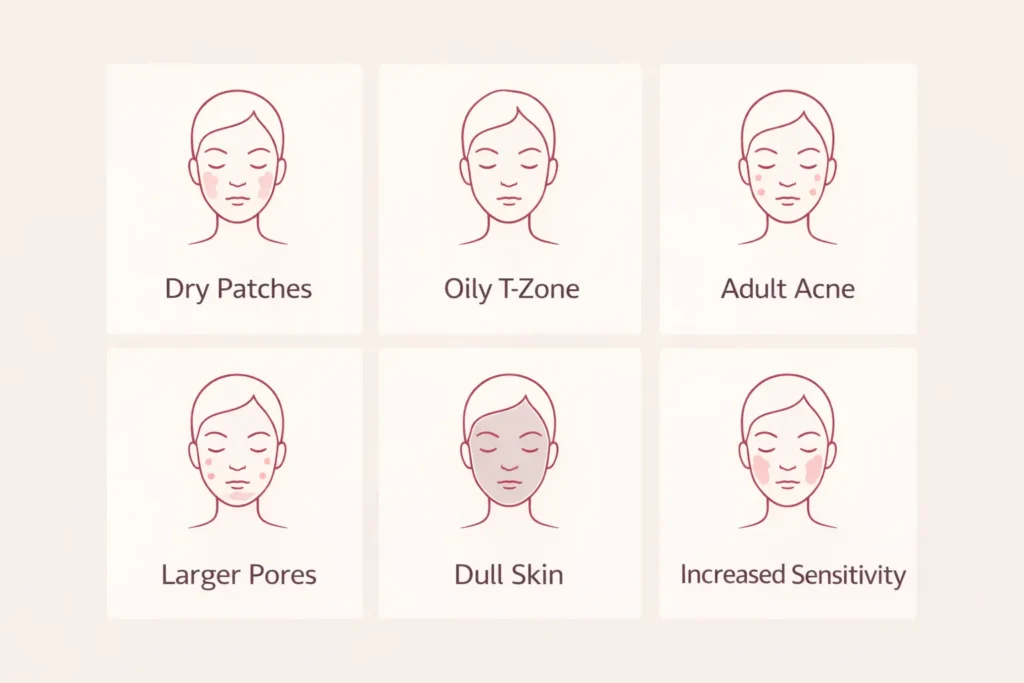
Illustrated grid of six common perimenopause skin symptoms including dry patches, oily T-zone, adult acne, larger pores, dull skin, and increased sensitivity

Dry-oily combination skin is rarely the only change. Around the same time, you might also notice:

  • More visible pores — lower estrogen reduces skin thickness and elasticity, making pores appear larger
  • Adult acne or breakouts — androgen activity and slowed cell turnover clog pores more easily
  • Skin that reacts more easily — a weakened barrier makes skin sensitive to products it handled fine before
  • Duller skin tone — slower cell turnover means dead skin stays on the surface longer
  • Fine lines appearing faster — collagen decline accelerates during perimenopause
  • Itchy or crawly skin — a lesser-known symptom linked to estrogen receptors in nerve endings

If you’re noticing two or more of these alongside the dry-oily confusion, perimenopause is a very likely explanation.

Short Answer: Common perimenopause skin changes include combination skin, adult acne, increased sensitivity, larger-looking pores, dullness, and faster-appearing fine lines — all driven by the same hormonal shifts.

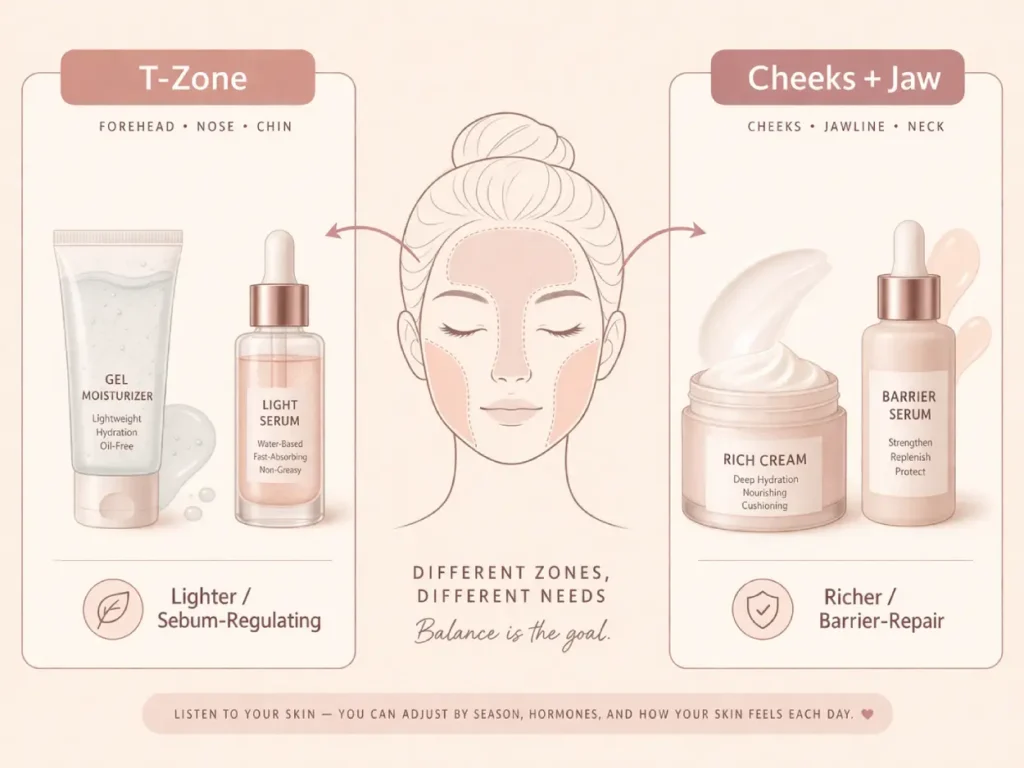
Illustrated zone-based skincare routine showing lighter products for the T-zone and richer barrier-repair products for cheeks and jaw in perimenopause combination skin

You don’t need to throw everything out. But understanding the hormonal root changes what to actually look for.

Support your barrier first. Look for ceramides, niacinamide, and peptides — ingredients that rebuild barrier function from the inside out — rather than just layering on more surface hydration.

Seal in your hyaluronic acid. On its own, HA can pull moisture out of skin in dry environments. Always layer it under a moisturizer that locks it in.

Add gentle exfoliation. Slower cell turnover means buildup happens faster now. A gentle chemical exfoliant once or twice a week clears the surface without stripping your barrier.

Try zone-based routines. Different products for different areas — lighter and mattifying on the T-zone, richer and barrier-focused on the cheeks and jaw — tend to outperform a single product applied everywhere during this skin transition.

What This Means: The goal isn’t to pick a skin type and treat the whole face the same way. It’s to support your barrier, regulate sebum gently, and meet each zone of your face where it actually is right now.

Q1: Can perimenopause really start at 38?

Yes. Perimenopause typically begins between 35 and 45, with 38–42 being a common window. Hormonal fluctuations can begin much earlier than most women expect — skin changes, mood shifts, and sleep disruption are often among the first signs, even before periods become irregular.

Q2: Why is my skin both dry and oily at the same time?

Dropping estrogen dries out your skin barrier while androgen activity increases oil production in your T-zone — both happening simultaneously. The two processes are independent, which is why different parts of your face behave completely differently.

Q3: Does perimenopause cause combination skin?

Yes — many women develop combination skin during perimenopause even if they never had it before. Estrogen normally helps regulate sebum production across the face. When it drops, t

Q4: What does perimenopause skin feel like?

Inconsistent. Tight and dry on the cheeks and jawline, oily or shiny in the T-zone, more sensitive to products, and sometimes breaking out along the jaw or chin. Pores may look larger and skin tone duller than it used to be.

Q5: Can hormones cause oily skin in your late 30s?

Yes. Even if you had balanced or dry skin your whole life, androgen and cortisol fluctuations during perimenopause can introduce new oiliness — especially in the T-zone. This is one of the more surprising early perimenopause skin changes.

Q6: How do I know if my skin problems are from perimenopause?

The clearest indicator is unexplained change — you didn't switch products, diet, or environment, but your skin behaves differently. Combination skin appearing for the first time in your late 30s, alongside disrupted sleep, mood shifts, or irregular cycles, is a strong signal worth discussing with a doctor.

Q7: Does estrogen affect skin oil production?

Yes. Estrogen helps regulate sebum output across the face. When it drops during perimenopause, oil glands become more reactive to androgen signals — particularly in the T-zone — which is why oiliness and dryness can appear on the same face simultaneously.

Q8: What skincare ingredients help perimenopause combination skin?

Ceramides, niacinamide, peptides, and gentle chemical exfoliants are the most consistently recommended starting points. They support barrier repair, regulate sebum gently, and assist with cell turnover — without worsening either the dry or the oily zones.

Q9: Is it normal to get adult acne during perimenopause?

Yes. Adult acne — especially along the jawline and chin — is a common perimenopause symptom driven by androgen activity and increased sebum production. Slower cell turnover also means pores clog more easily than they used to.

Q10: Can perimenopause make your skin more sensitive?

Yes. Declining estrogen weakens the skin barrier, making skin more reactive to products, fragrances, and environmental triggers. Many women find that products they used for years suddenly cause irritation or redness during perimenopause.

Q11: At what age does perimenopause skin change start?

As early as 35–38 for many women, though the average onset is around 40–44. Skin changes are often among the earliest perimenopausal symptoms — sometimes appearing well before menstrual irregularities begin.

Q12: Should I see a doctor about perimenopause skin changes?

Yes — especially if the changes are significant or affecting your confidence. A dermatologist can address specific skin concerns, and a gynecologist or women's health specialist can assess whether hormonal support makes sense. Both perspectives working together tend to produce the best outcomes.
Ponytail Thinner at 43? It’s Perimenopause

You keep wrapping the hair tie one more time than you used to. Or you move the elastic higher up to get the same grip. Maybe you noticed it in a photo—your ponytail looking… smaller. Less substantial. At 43, this isn’t your imagination, and it isn’t just “getting older.” It’s your body’s hormonal shift announcing that perimenopause has arrived, and your hair follicles are the first responders.

Women have a built-in metric they rarely talk about: the ponytail circumference test. You feel it when you gather your hair—the density in your palm, the resistance when you wrap the elastic. Most women unconsciously track this over years. When your standard hair tie goes from wrapping twice to three times, or when you switch from “medium” to “small” scrunchies, you’re measuring something dermatologists call

This happens because you’re touching the of 90,000+ follicles. Even a 10% reduction in individual strand diameter creates a 30-50% reduction in total ponytail volume. Your bathroom mirror might not show the diffuse thinning—hair loss spreads evenly across the scalp—but your hands detect the circumference change immediately.

At 43, you’ve lost approximately 15-20% of your peak estrogen levels compared to age 35. This percentage matters because estrogen acts as a protective shield against DHT, the hormone derivative that causes follicle shrinkage. When that shield thins, the attack begins.

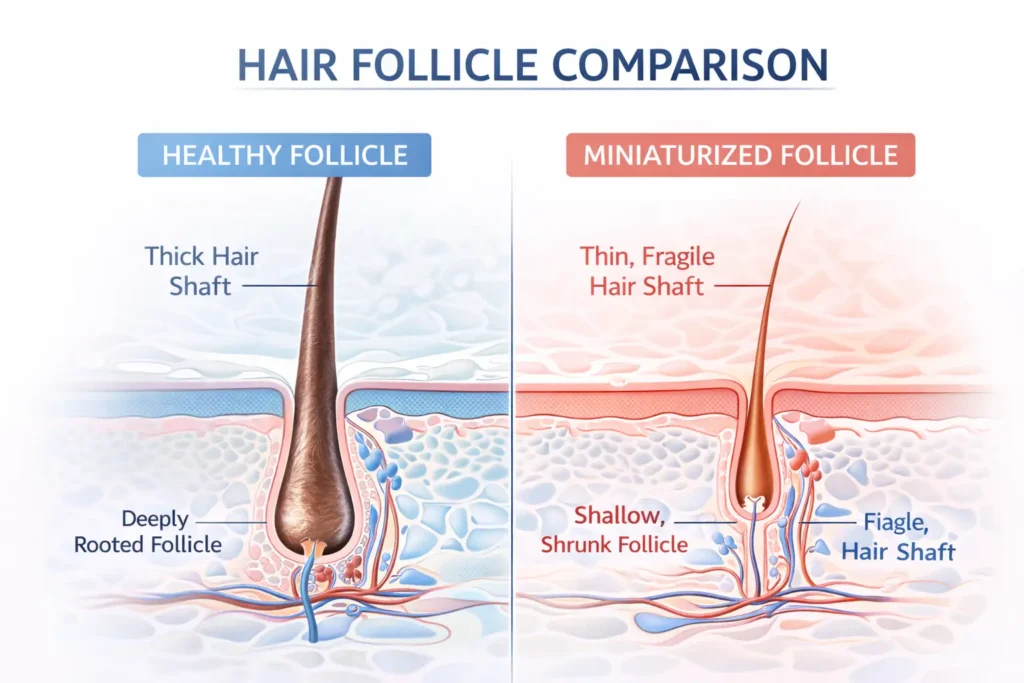
Diagram showing hair follicle miniaturization during perimenopause DHT effect

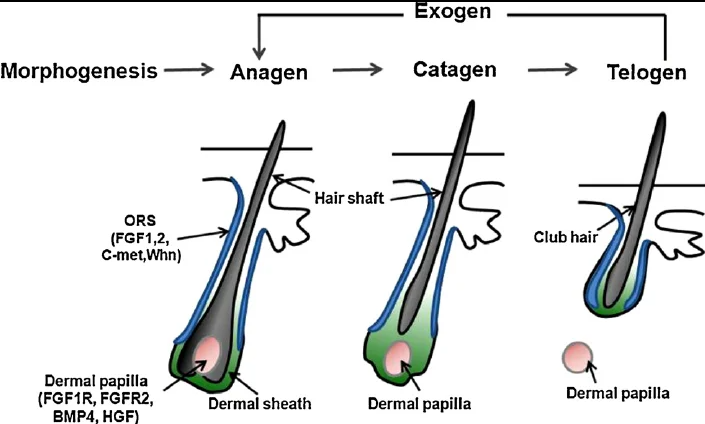
Here’s the mechanism your dermatologist sees under the microscope: Each follicle contains androgen receptors. When  binds to these receptors in genetically predisposed follicles (typically at the crown and front), it triggers a process called . The follicle literally shrinks, producing a finer hair shaft with a shorter growth cycle.

Normally, estrogen blocks this binding or reduces the follicle’s sensitivity to DHT. During perimenopause, as estradiol levels drop, that blocking effect weakens. The result? Anagen (growth) phases shorten from 4-7 years to 2-3 years. Your hair doesn’t just fall out—it grows back thinner, creating the “diffuse thinning” that shows up first in your ponytail diameter.

 You’re not necessarily losing more hair; you’re losing in the hair you keep.

What This Means: Your follicles aren’t dying; they’re shrinking. The hair strand gets progressively skinnier, like a pencil becoming a thread, which is why the ponytail feels smaller before the scalp becomes visible.

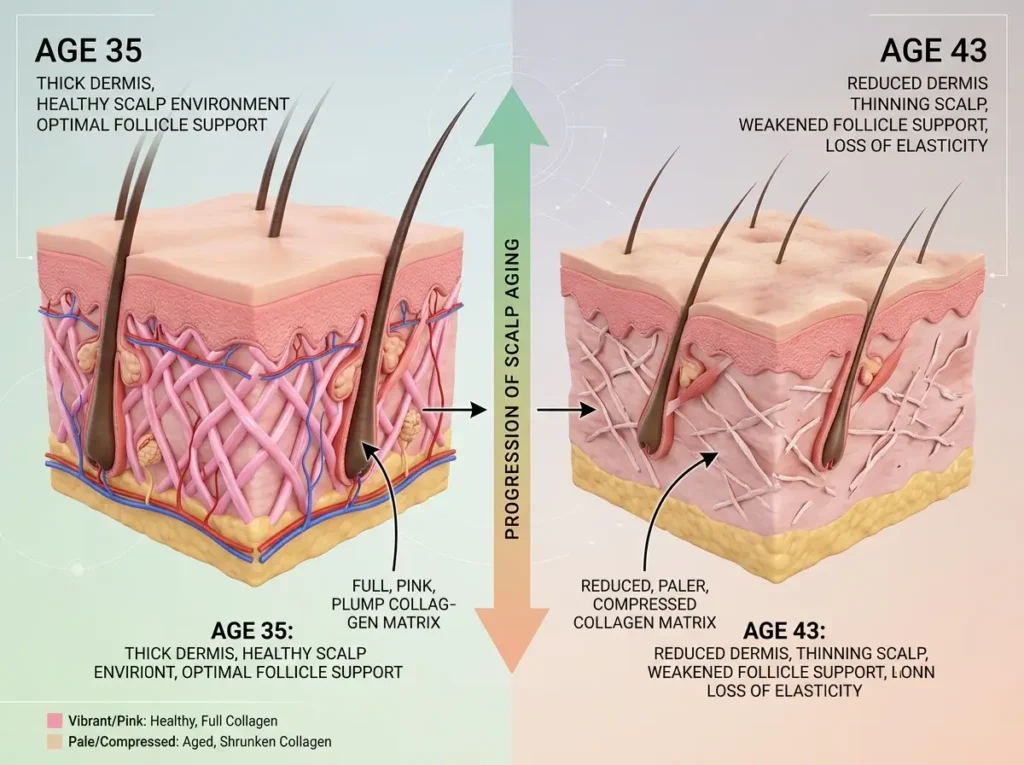
Scalp collagen reduction comparison age 35 versus 43 perimenopause

There’s a second mechanism rarely discussed: your scalp is shrinking. Estrogen stimulates collagen production in the dermal layer where follicles anchor. As levels drop during perimenopause, scalp collagen decreases by 1-2% annually after 40. This reduces the physical surface area and blood flow supporting each follicle.

Less collagen means less “padding” and circulation. The follicles don’t just miniaturize—they get squeezed in a tightening environment. This creates the specific “my ponytail feels different” sensation: the hair isn’t just thinner, but the scalp feels tighter when you pull it back.

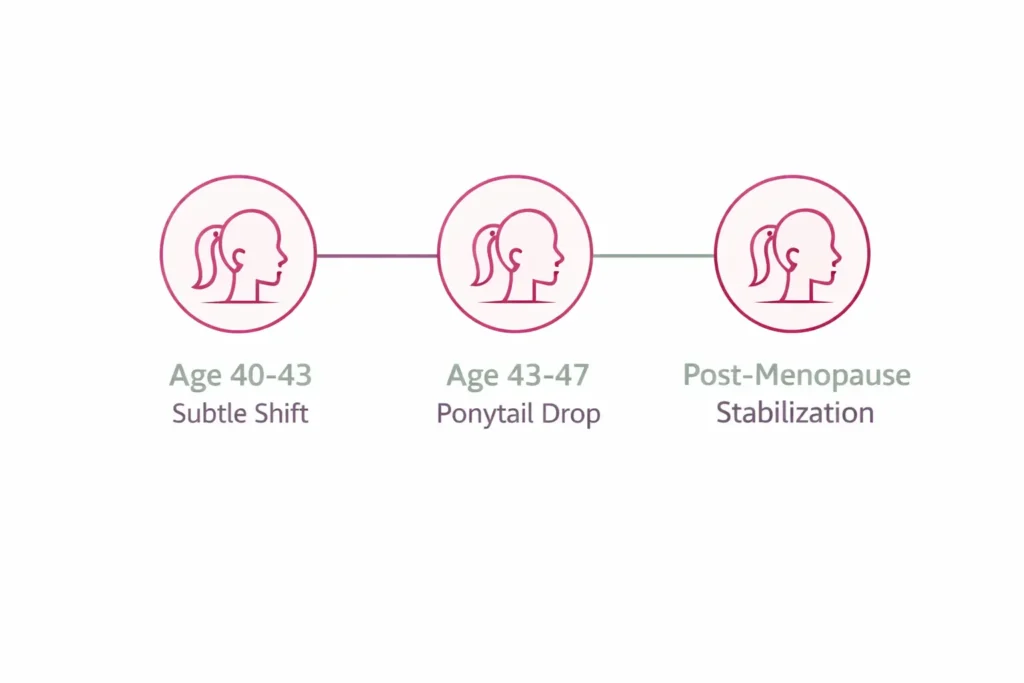
Three stages of perimenopause hair thinning timeline age 40 to menopause

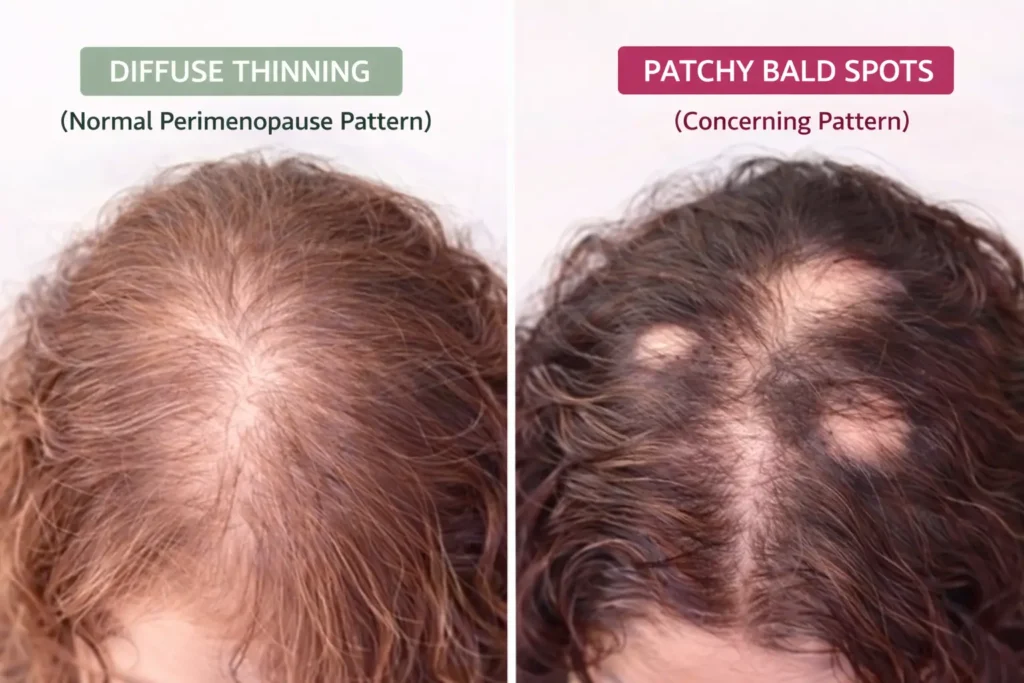
Normal perimenopause hair thinning versus patchy hair loss red flags

While thinning at 43 is typically hormonal, certain patterns indicate other causes:

If your ponytail changed overnight (within 3 months) rather than gradually over 1-2 years, see a dermatologist. True perimenopause thinning is gradual; you notice the ponytail difference retrospectively, not overnight.

You cannot stop the hormonal shift—it’s baked into the aging process—but you can influence how severely it manifests:

Cortisol competes with progesterone, accelerating the estrogen decline. High stress at 43 speeds up the hair thinning timeline. Prioritizing sleep and cortisol reduction won’t reverse miniaturization but can prevent premature telogen effluvium (stress shedding) from compounding the hormonal loss.

Hair is keratin—protein. The follicle’s nutrient priority drops during perimenopause as the body redirects resources. Aim for 25-30g protein within 30 minutes of waking to signal “resources available” to hair follicles.

 Miniaturized follicles are vulnerable follicles. Avoid tight ponytails (traction alopecia hormonal thinning is irreversible) and keep the scalp clean—sebum buildup further shrinks the follicle opening.

A dermatologist can perform a trichoscopy to confirm miniaturization patterns specific to androgenic thinning versus other causes. Knowledge is validation; validation reduces stress; reduced stress slows additional shedding.

Q: Why does my ponytail feel thinner specifically at age 43?

A: Age 43 represents the statistical peak of early perimenopause, when estrogen levels have dropped sufficiently to allow DHT to begin miniaturizing hair follicles, reducing strand diameter and ponytail circumference.

Q: Is my ponytail actually thinner or am I just imagining it?

A: You're not imagining it. Objective measurement shows ponytail circumference decreases 30-50% during perimenopause due to follicle miniaturization. Most women detect this before visible scalp thinning appears.

Q: What's the difference between perimenopause thinning and regular aging?

A: Perimenopause thinning is rapid, diffuse, and hormonally driven (ages 40-50), while general aging hair loss happens gradually over decades (50-70). Perimenopause accelerates thinning to 10-15% per year versus 10% per decade.

Q: Can the ponytail test diagnose hair loss?

A: No, it's a self-monitoring tool, not a diagnosis, but consistent circumference reduction correlates strongly with clinical miniaturization patterns.

Q: Will my hair return to normal after menopause?

A: No, miniaturized follicles don't return to previous size, but thinning stabilizes and shedding decreases significantly post-menopause.

Q: Why does my hair tie wrap more times around my ponytail now?

A: Reduced hair circumference means less resistance against the elastic. If your tie went from 2 wraps to 3-4, you've likely lost 30-40% of ponytail volume.

Q: Is this type of hair loss permanent?

A: The thinning is permanent in that miniaturized follicles don't enlarge, but the progression halts after menopause.

Q: How is perimenopause hair thinning different from male pattern baldness?

A: Women experience diffuse thinning maintaining the hairline; men experience patterned recession and crown balding.

Q: Can stress at 43 make my ponytail thinner faster?

A: Yes. Cortisol spikes accelerate the shift from growth to shedding phases, compounding hormonal thinning.

Q: Should I see a doctor if I notice my ponytail shrinking at 43?

A: Yes, to rule out thyroid issues or autoimmune conditions, though perimenopause is the most likely cause at this age.

Q: Why do I notice the ponytail change before seeing scalp thinning?

A: The ponytail aggregates all hair; diffuse thinning shows in volume loss before scalp visibility. You need to lose ~50% density before scalp shows.

Q: Does this mean I'm going bald?

A: No. Perimenopause causes thinning (reduced density), not balding (complete follicle death). Women rarely go bald from hormonal changes.

Why Daylight Makes Your Skin Look Different After 35

You catch yourself in the bathroom mirror and everything looks fine. Then you walk outside — or sit near a window — and suddenly every texture, every pore, every uneven patch is visible in a way it wasn’t two minutes ago. It feels jarring. Like your skin changed overnight.

It didn’t change in that moment. After 35, four biological shifts — collagen decline, slower cell turnover, hormonal fluctuation, and a thinning skin barrier — work together to change how your skin’s surface interacts with light. Natural daylight simply has no filter. It shows all of it at once.

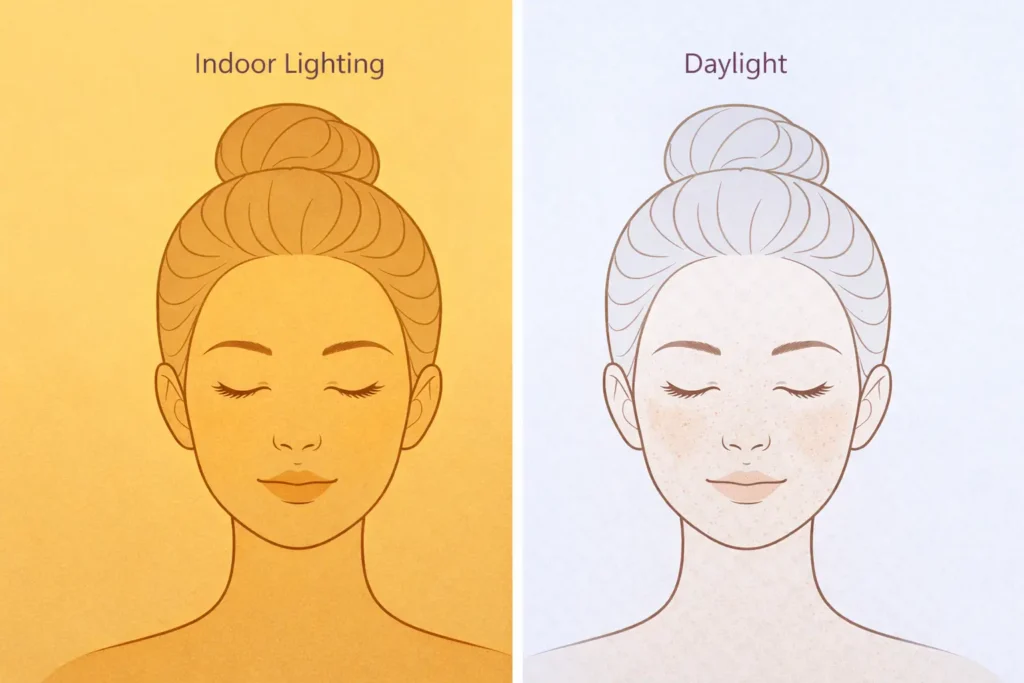
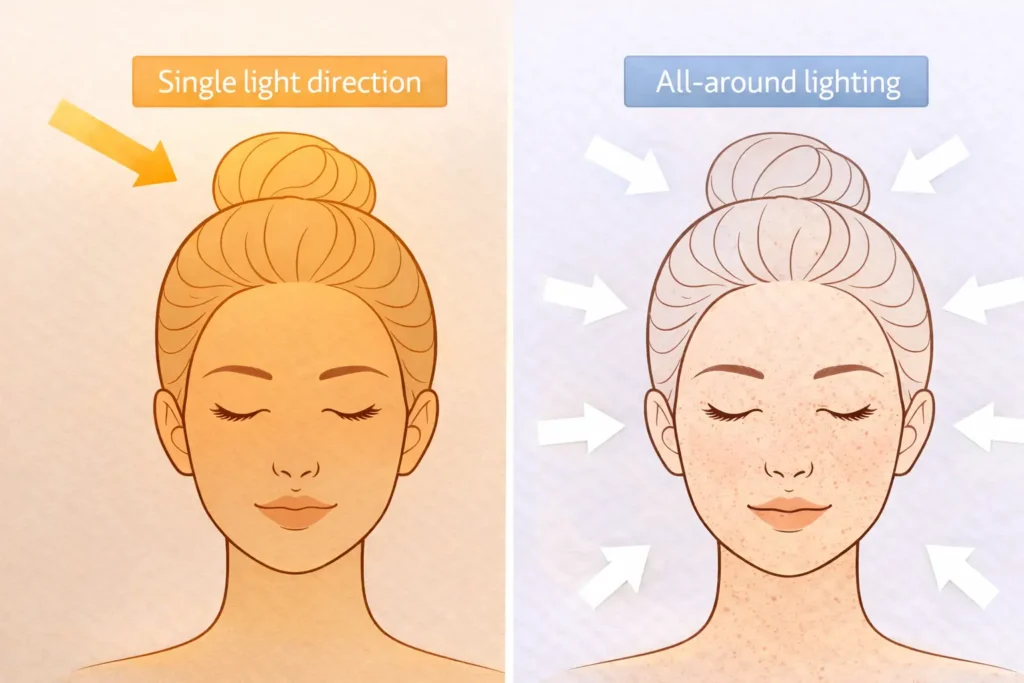
Split illustration comparing skin appearance under warm indoor light versus natural daylight

Indoor lighting — lamps, overhead bulbs, bathroom fixtures — typically comes from one direction and casts a warm, even glow. It creates soft shadows that smooth out texture and minimize uneven tone. Natural daylight works completely differently. It is unfiltered and comes from multiple angles simultaneously, landing on every surface of your face at once.

That means it catches the edges of pores, the slight variation in skin texture across different zones, and the way light bounces differently off areas with more or less hydration. It reveals surface variation in a way that a single warm overhead source simply cannot.

After 35, your skin has more of that surface variation than it used to. Daylight is not making your skin look bad. It is showing you exactly what is there.

Short Answer: Natural daylight hits skin from multiple angles with no filter, making texture, pores, and tone differences visible in ways indoor lighting hides. After 35, biological changes give daylight more to show.

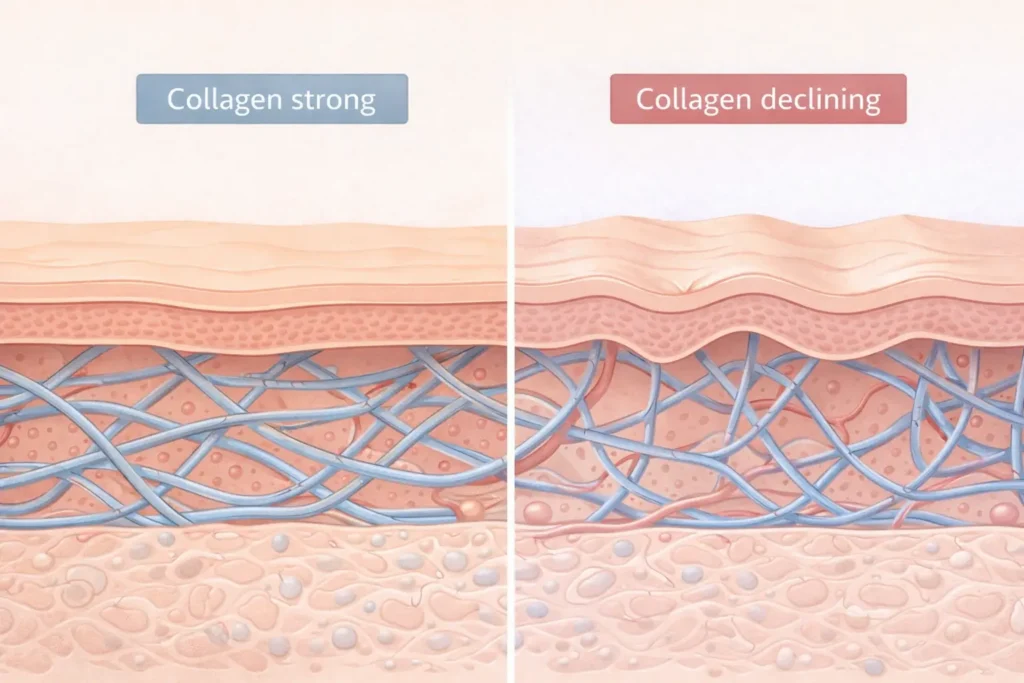
Illustrated cross-section comparing strong collagen skin structure versus declining collagen after 35

Collagen is the structural protein that keeps skin firm, plump, and smooth. Production begins slowing in your late 20s and accelerates noticeably after 35. At the same time, the collagen already in place breaks down faster than it gets replaced.

What does that look like on your face? Skin becomes slightly thinner. It loses some of its internal scaffolding. The surface shows fine lines, subtle texture shifts, and areas that no longer sit as tautly as they did. In indoor lighting, these changes are easy to miss. In daylight, multi-angle light exposure makes them immediately visible.

Elastin — the protein responsible for skin’s bounce — declines alongside collagen. Together, their loss changes how the skin’s surface scatters light. Younger skin reflects light more evenly because the surface is smoother and more uniform. After 35, that surface has more variation, and daylight shows all of it at once.

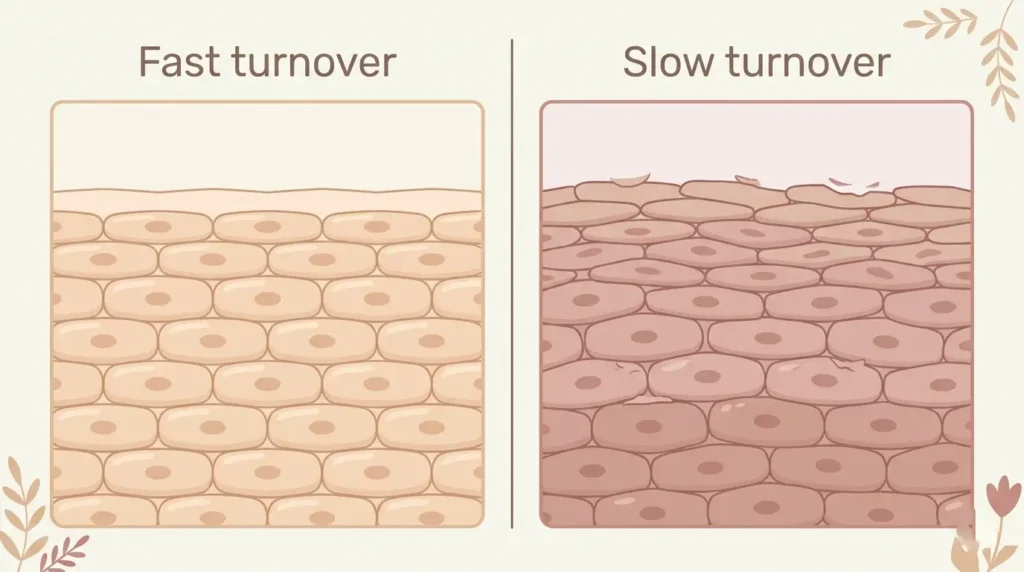
Illustration comparing fast and slow skin cell turnover and effect on surface appearance after 35

In your 20s, your skin sheds and replaces surface cells roughly every 28 days. After 35, that cycle stretches to 40, 50, or even 60 days. Dead skin cells sit on the surface longer before fresh ones replace them.

The result is a surface that is slightly duller, slightly rougher, and less even in tone. In indoor lighting, this reads as skin that looks a little tired. In natural daylight, it appears clearly — as dullness, as micro-texture, as patches of uneven tone that seem to arrive from nowhere.

This is also why skin can look grayish or flat in bright light. The surface layer is not reflecting light cleanly the way fresh cells do. It is absorbing and scattering it instead.

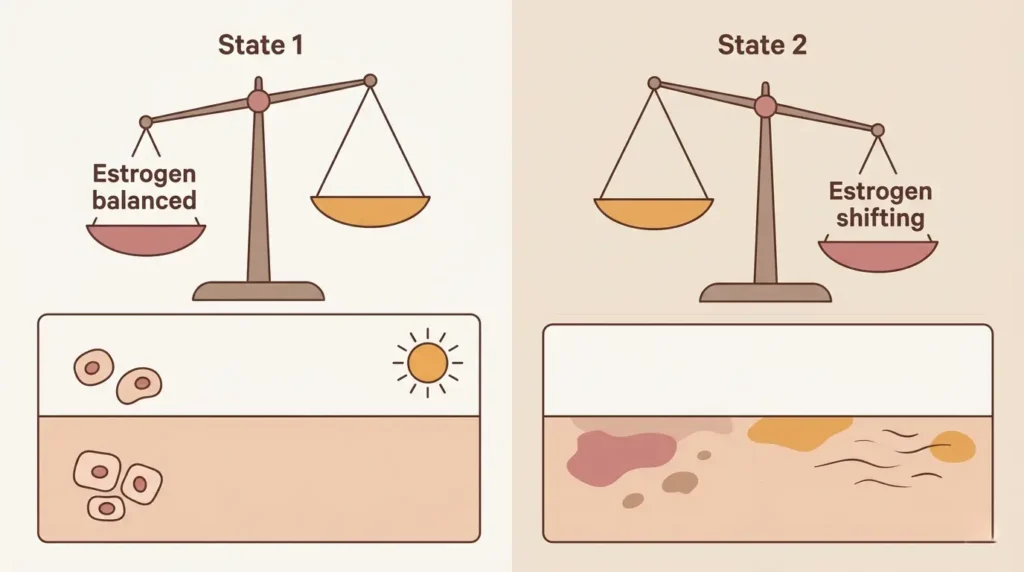
Illustrated diagram showing estrogen balance versus estrogen decline and effect on skin tone and texture

Estrogen plays a direct role in skin health — it supports collagen production, helps skin retain moisture, and keeps surface tone more even. Starting in the mid-30s, estrogen levels begin shifting unpredictably, especially as perimenopause begins.

As estrogen fluctuates, skin loses some of its moisture-retention ability. Melanin production — the pigment responsible for skin color — becomes less regulated, leading to patches of hyperpigmentation, uneven tone, or subtle blotchiness that were not present before.

In daylight, all of this appears simultaneously. Slightly thinner skin, less even pigmentation, and reduced moisture create a surface that reflects light differently across different zones — which shows up as unevenness or dullness depending on the angle.

Short Answer: Estrogen shifts after 35 reduce moisture retention and disrupt melanin regulation, creating uneven tone and texture that natural light makes immediately visible.

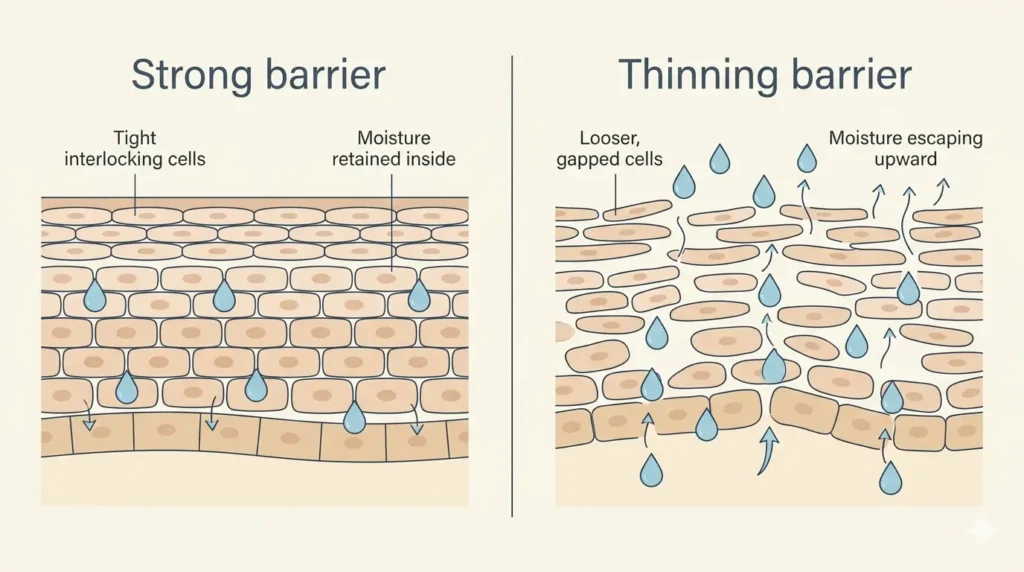
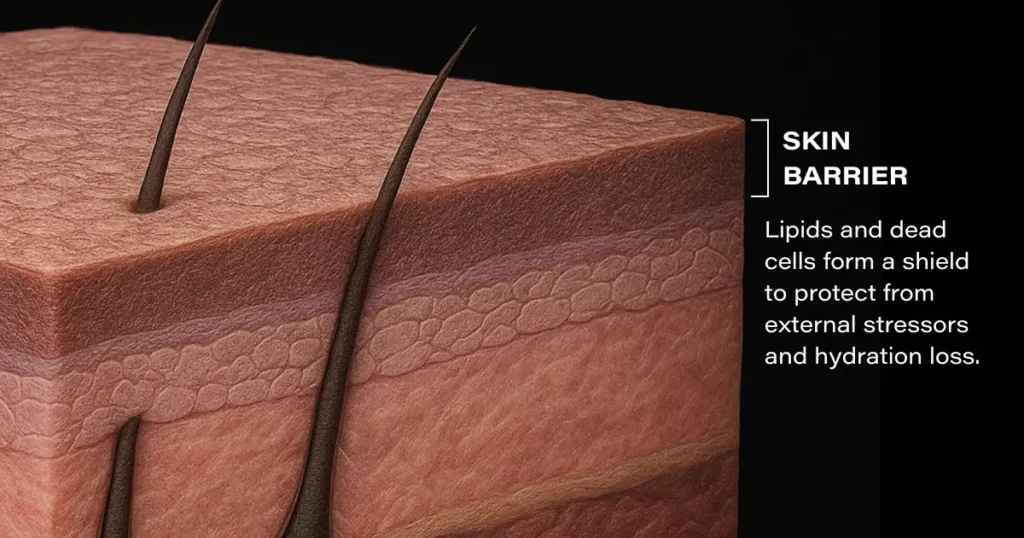
The skin barrier is the outermost layer of your skin. A healthy barrier holds moisture in, keeps irritants out, and reflects light evenly — giving skin that natural, hydrated glow. A weakened barrier does the opposite. It loses water faster, becomes more reactive, and creates a surface that looks flat and dull regardless of how much moisturizer you apply.

After 35, ceramide production — the lipids that hold barrier cells together — slows down. The barrier thins. Skin loses water faster, becomes more sensitive to products it once tolerated easily, and loses its natural luminosity. In daylight, a compromised barrier shows as skin that looks tired, dry at the edges, or strangely flat even when it does not feel dry.

Short Answer: A thinning skin barrier after 35 allows moisture loss and reduces natural radiance. Daylight exposes this as dullness, dryness, or flat-looking skin.

Diagram showing directional indoor lighting versus multi-directional daylight and their effect on visible skin texture

Most indoor lighting is directional and warm-toned. It comes from above or one side, creating soft shadows that smooth texture across the face. The warm amber and yellow tones in standard bulbs minimize the appearance of redness, uneven pigmentation, and fine lines.

Natural daylight is cool, neutral, and multi-directional. It does not create softening shadows. It lands on the entire face evenly at once — so nothing gets hidden. Every slight texture variation, every pore edge, every patch of uneven pigment is lit simultaneously.

This is why the bathroom mirror and the car mirror can look like two entirely different faces. The skin is the same. The light is giving you more complete — and more honest — information about it.

Short Answer: Indoor lighting is warm and directional, which softens texture and hides unevenness. Daylight is neutral and multi-directional — it reveals everything equally.

Woman in her early 40s calmly looking at her reflection in natural light — understanding skin changes after 35

Understanding why daylight shows more does not make the experience less surprising — but it does change the frame entirely. What you are seeing is not damage or failure. It is biology doing exactly what it does over time.

Collagen loss becomes visually noticeable for most women by the early 40s. Cell turnover slowdown is often detectable on the skin’s surface from the mid-30s onward. Skin barrier thinning tends to accelerate once estrogen begins shifting — which for many women starts between 38 and 45. These changes do not all arrive at once, but they often overlap in the same window — which is exactly why the daylight shift feels sudden even when it has been gradual.

Daylight is an honest light source. Knowing what is actually changing beneath the surface is a far more useful place to start than assuming your moisturizer stopped working.

Q1: Why does my skin look so much worse in natural light after 35?

Natural light is unfiltered and multi-directional, so it shows texture, pores, and tone differences that indoor lighting softens. After 35, collagen loss, slower cell turnover, hormonal shifts, and a thinning skin barrier all change how your skin's surface reflects light — and daylight reveals all of it simultaneously. Schema: Natural light exposes skin texture and tone changes that occur after 35 due to collagen decline, slower cell turnover, and hormonal shifts — changes that indoor lighting typically softens or hides.

Q2: Is it normal for skin to look different in daylight after 35?

Yes — extremely common and driven entirely by biology. Most women notice this shift between 35 and 45. It is not caused by wrong products or poor skincare habits. It is the result of collagen declining, estrogen fluctuating, and cell turnover slowing — all normal parts of how skin changes with age. Schema: Yes, skin looking visibly different in natural light after 35 is a normal biological change experienced by most women in this age range.

Q3: Why do my pores look so much bigger in sunlight after 35?

Pores do not actually get larger — but the skin around them loses firmness, making them appear more prominent. Collagen and elastin support the structure around each pore. As both decline after 35, that support weakens. In daylight, multi-directional light catches pore edges more clearly than soft indoor lighting does. Schema: Pores appear larger in daylight after 35 because declining collagen and elastin reduce the skin structure around them, and natural light highlights their edges more clearly than indoor lighting.

Q4: Why does my skin look dull in natural light but fine indoors?

Slower cell turnover after 35 leaves older, duller cells on the surface longer. Fresh skin cells reflect light evenly, creating a natural glow. As turnover slows, dead cells accumulate and scatter light unevenly. Warm indoor lighting masks this. Neutral daylight exposes it clearly as dullness or flatness. Schema: Skin looks dull in natural light after 35 because slower cell turnover leaves a less reflective surface that daylight exposes, while warm indoor lighting softens the effect.

Q5: Does estrogen affect how skin looks in natural light?

Yes. Estrogen supports collagen, moisture retention, and even pigmentation — all of which affect how skin reflects light. As estrogen shifts during perimenopause — which can begin in the mid-30s — skin loses moisture and becomes less even in tone. Daylight makes this visible as blotchiness or unevenness across different zones of the face. Schema: Yes, estrogen decline after 35 reduces skin moisture and disrupts pigmentation regulation, making uneven tone and texture more visible in natural daylight.

Q6: Why does my face look uneven in daylight but not in indoor photos or mirrors?

Indoor lighting and most phone cameras apply softening effects that daylight does not. Most indoor environments use warm, directional light that creates flattering shadows. Phone cameras process images to smooth texture. Natural daylight is cool, unfiltered, and hits the face from all angles at once — removing those softening effects entirely and showing the skin's true surface. Schema: Indoor lighting and cameras soften texture with warm tones and processing. Natural daylight is unfiltered and multi-directional, revealing skin surface differences that other light sources minimize.

Q7: What causes skin texture to suddenly look rough after 35?

Slower cell turnover, collagen loss, and a weakening skin barrier all contribute. When skin renews itself less frequently, older cells build up and create micro-texture. The loss of collagen and ceramides means the skin surface is less smooth and less able to hold moisture evenly — both of which make texture more visible in bright light. Schema: Rough skin texture after 35 results from slower cell turnover, collagen decline, and reduced ceramide production — all creating a less smooth, less even surface that natural light makes clearly visible.

Q8: Can anything improve how skin looks in daylight after 35?

Consistent skincare can improve some of what daylight reveals, though the biological shift is real and ongoing. Retinoids and peptides support collagen. Gentle chemical exfoliants accelerate cell turnover. Ceramides and niacinamide repair and strengthen the skin barrier — which directly affects how evenly skin reflects light. Results develop over months, not days, and work best when the routine is built around understanding what is actually changing rather than chasing a fix. Schema: Skincare ingredients that support collagen, cell turnover, and barrier repair can improve how skin appears in natural light after 35, though results develop gradually over time.

Q9: Does perimenopause make skin look worse in daylight?

Yes — perimenopause accelerates several changes that make skin surface differences more visible in natural light. It can begin as early as 35 and brings estrogen fluctuations that affect moisture, pigmentation, and collagen simultaneously. For many women between 38 and 48, this is the period when the daylight difference becomes most noticeable. Schema: Yes, perimenopause accelerates collagen loss, moisture reduction, and pigmentation unevenness — all of which make skin look more visibly changed in natural daylight.

Q10: Why does my skin look fine at night but different during the day?

Evening lighting — lamps, candles, warm overhead bulbs — casts a soft, golden tone that minimizes contrast and smooths what it touches. Skin looks better in that light at any age. Daytime natural light is the opposite: cool, neutral, and multi-directional. The difference is not your skin changing between morning and night. It is two fundamentally different light sources telling you two different amounts of information. Schema: Warm artificial lighting at night flatters skin by softening texture and minimizing contrast. Daylight is cooler and multi-directional, which reveals skin surface changes more clearly regardless of age.

How Perimenopause Affects Skin and Hair in Women Over 30

QUICK ANSWERS

Short Answer : Perimenopause changes your skin and hair by affecting moisture retention, surface texture, and natural growth cycles. This is driven by hormonal shifts, specifically the gradual decline of estrogen.

If You’re Noticing This : If your makeup suddenly doesn’t sit right, your skin feels dry but looks oily, or your hair isn’t  growing like it used to these are often early signs of perimenopause.

What This Means : These changes are rarely caused by using the wrong products or having a bad routine. They are internal hormonal shifts showing up externally.

It usually doesn’t start with something dramatic. Most women in their 30s and early 40s notice small, frustrating inconsistencies first.

Nothing seems clearly “wrong,” but something isn’t the same. That subtle shift is usually the first signal that your hormones are transitioning. Instead of blaming your skincare routine, it helps to know what to look for.

Here are the five most common early signs that perimenopause is affecting your skin and hair.

Your Skin Feels Dry, But Still Gets Oily

You apply your foundation in the morning, and it looks fine in the bathroom mirror. But when you check your reflection in natural daylight a few hours later, it looks patchy or separated. This happens because your skin’s surface texture and moisture barrier are changing, preventing makeup from gripping and sitting evenly on the skin.

Your Makeup Separates or Looks Uneven by Midday

This is one of the most confusing phases for women over 30. Your skin might feel tight, dry, and lacking moisture, yet you still develop a shiny or oily layer throughout the day. Hormonal shifts disrupt both hydration levels and sebum (oil) production, creating an environment where skin is simultaneously dehydrated and oily.

Your Go-To Products Suddenly Stop Working

You haven’t changed your routine, but the results have flat lined. The moisturizer that used to give you a glow now leaves you looking dull. It’s not that the products went bad; it’s that your skin is responding differently. Your skin’s baseline needs have changed, making your old routine obsolete.

Your hair looks perfectly healthy, but it seems stuck. Maybe it refuses to grow past your shoulders, no matter how few heat tools you use. This isn’t necessarily breakage. During perimenopause, your hair’s natural growth cycle begins to shorten. The hair simply doesn’t stay in the active growth phase as long as it used to.

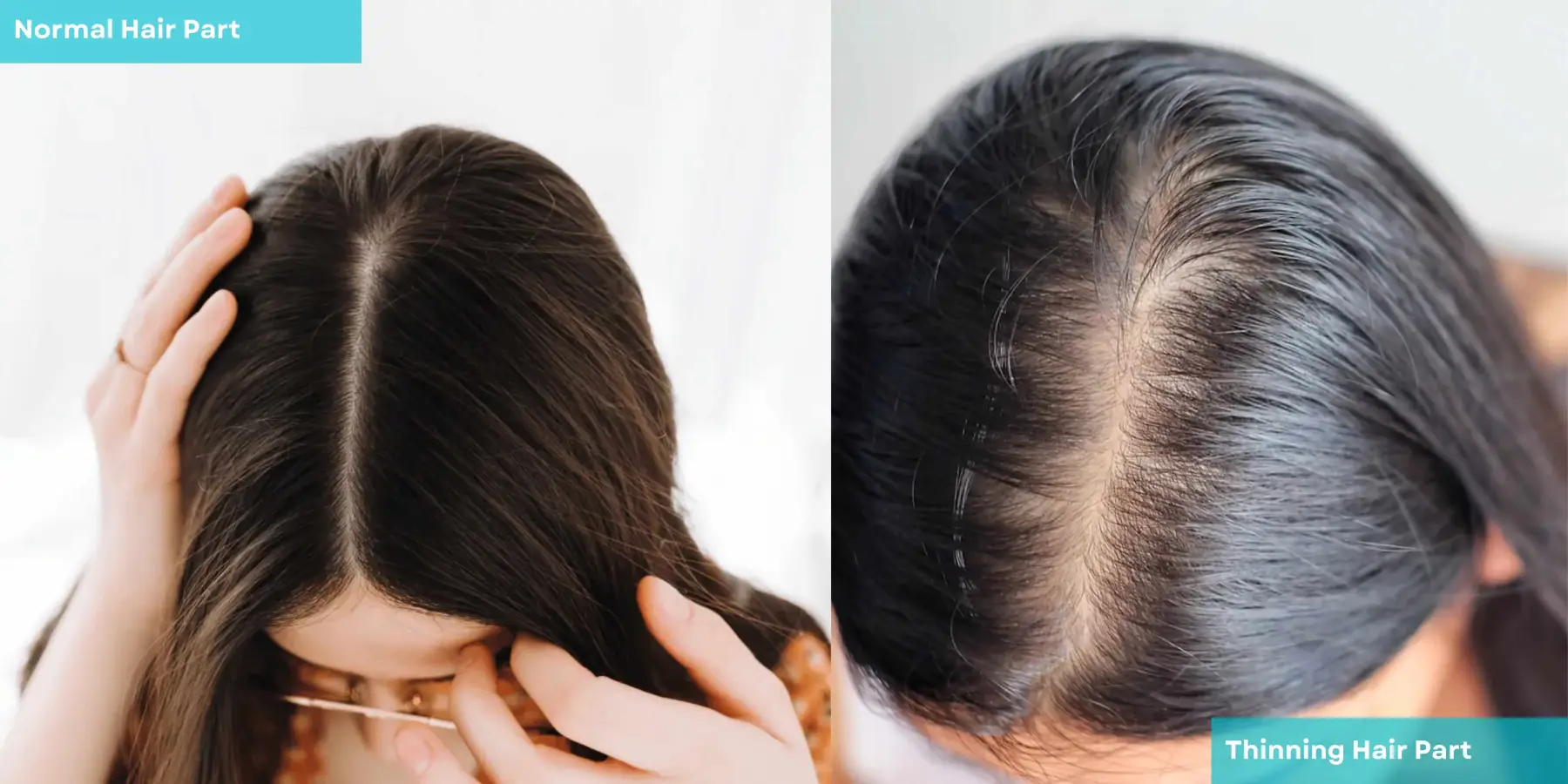
Hair changes often feel confusing because they don’t always look like traditional damage. You might notice more hair shedding in the shower or a slight widening of your part line, along with less overall volume. Again, the structure of the hair is fine—the issue stems from the changing growth cycle at the follicle level.

During perimenopause, your hormone levels begin to fluctuate. One of the biggest drivers behind these physical changes is a gradual decline in estrogen.

You don’t see the hormone change directly. You see the result of it. Estrogen directly influences:

  1. How well your skin holds onto moisture.
  2. How smooth, thick, or elastic your skin feels.
  3. How long your hair stays in its active growth phase.

When estrogen drops, your skin barrier stops behaving the way it did in your 20s. It’s not that your skin is “bad”—it’s simply functioning under a new set of rules.

The Frustration Loop Most Women Go Through

Because these changes are subtle, most women don’t immediately connect them to perimenopause. Instead, the thought process usually looks like this:

  1. “Maybe I bought the wrong product.”
  2. “Maybe my routine stopped working.”
  3. “Maybe my skin is just getting worse.”

This kicks off a cycle. You notice something feels off, so you buy new skincare or hair products. The results don’t match your expectations, so you feel more confused, and you buy something else. This loop can repeat for months or even years.

When you step back and look at all these changes together, a clear pattern forms. It’s not random, and it’s not something you did wrong. It’s your body going through a natural transition, and your skin and hair are just the first places it shows.

1.What are the earliest signs of perimenopause on skin? 

The earliest signs are usually subtle changes in texture, underlying dryness, and a shift in how makeup sits on your face. Many women notice their skin behaving unpredictably before they experience any other traditional perimenopause symptoms.

2.Does perimenopause affect hair growth? 

Yes. Hair may grow more slowly or stop reaching the same length as before. This happens because the active growth phase of the hair follicle becomes shorter due to hormonal shifts.

3.Why does my skin feel dry and oily at the same time? 

Hormonal fluctuations disrupt both your skin’s oil production and its ability to retain water. This creates a confusing mix of dehydration (dryness) and excess sebum (shine) happening at the exact same time.

4.Why is my makeup suddenly separating? 

Changes in your skin’s texture and natural moisture levels can prevent foundation and concealer from laying flat. Even if you use the exact same products, the canvas underneath has changed.

5.Why is my hair thinning but not damaged? 

The change is happening in the hair growth cycle, not within the hair shaft itself. Your hair can look incredibly healthy and shiny, but still feel thinner because the follicles are shedding hair faster than before.

6.Can perimenopause start in your 30s?

 Yes. For some women, the perimenopause transition can begin in their early to mid-30s, almost always starting with very subtle, easily dismissed symptoms like skin and hair changes.

7.Why do my old skincare products stop working? Y

our skin’s core needs shift during perimenopause. A moisturizer designed for a 25-year-old’s estrogen-rich skin barrier will no longer match the exact hydration requirements of your skin in your late 30s.

8.Is hair loss during perimenopause permanent? 

Not always. In many cases, perimenopausal hair thinning is related to temporary hormonal fluctuations rather than permanent follicle damage or male/female pattern baldness.