


Ponytail Thinner at 43?
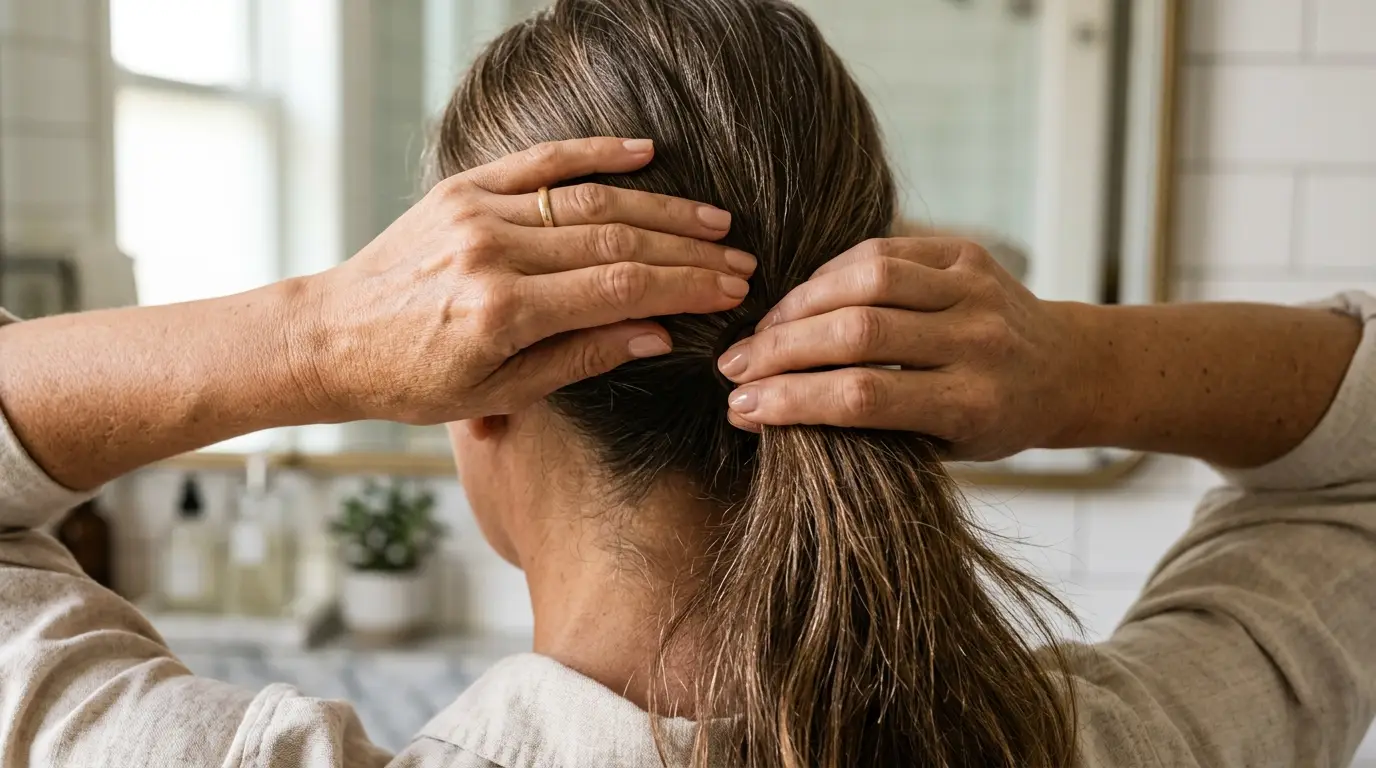
You keep wrapping the hair tie one more time than you used to. Or you move the elastic higher up to get the same grip. Maybe you noticed it in a photo—your ponytail looking… smaller. Less substantial. At 43, this isn’t your imagination, and it isn’t just “getting older.” It’s your body’s hormonal shift announcing that perimenopause has arrived, and your hair follicles are the first responders.
Quick Answers
Why does my ponytail feel thinner at 43?
Perimenopause reduces estrogen’s protective effect on hair follicles, allowing DHT (dihydrotestosterone) to shrink them. This miniaturization produces finer hair strands and reduces overall ponytail circumference by up to 50%.
Is this normal or am I actually losing my hair?
It’s a normal physiological change affecting 40-50% of women by age 43. Unlike clinical alopecia, this is diffuse thinning (reduced density) rather than patchy hair loss, and it stabilizes post-menopause.
How can I measure this objectively?
Use the “ponytail test”: Track how many times a standard hair tie wraps around your ponytail base. Progression from 2 wraps to 3-4, or needing to move the tie higher to achieve tension, indicates measurable thinning.
The Ponytail Test: Your Hands Know Before Your Eyes Do
Women have a built-in metric they rarely talk about: the ponytail circumference test. You feel it when you gather your hair—the density in your palm, the resistance when you wrap the elastic. Most women unconsciously track this over years. When your standard hair tie goes from wrapping twice to three times, or when you switch from “medium” to “small” scrunchies, you’re measuring something dermatologists call
This happens because you’re touching the of 90,000+ follicles. Even a 10% reduction in individual strand diameter creates a 30-50% reduction in total ponytail volume. Your bathroom mirror might not show the diffuse thinning—hair loss spreads evenly across the scalp—but your hands detect the circumference change immediately.
Why 43 Is the Biological Tipping Point
The average woman enters perimenopause between ages 40 and 44, with 43 marking the statistical peak for noticeable symptoms. During this window, estrogen doesn’t decline gracefully—it fluctuates wildly before dropping permanently. This erratic pattern creates temporary windows where (like DHT) gain influence over your hair follicles.
At 43, you’ve lost approximately 15-20% of your peak estrogen levels compared to age 35. This percentage matters because estrogen acts as a protective shield against DHT, the hormone derivative that causes follicle shrinkage. When that shield thins, the attack begins.
The Science: Estrogen Drops, DHT Takes Over

Here’s the mechanism your dermatologist sees under the microscope: Each follicle contains androgen receptors. When binds to these receptors in genetically predisposed follicles (typically at the crown and front), it triggers a process called . The follicle literally shrinks, producing a finer hair shaft with a shorter growth cycle.
Normally, estrogen blocks this binding or reduces the follicle’s sensitivity to DHT. During perimenopause, as estradiol levels drop, that blocking effect weakens. The result? Anagen (growth) phases shorten from 4-7 years to 2-3 years. Your hair doesn’t just fall out—it grows back thinner, creating the “diffuse thinning” that shows up first in your ponytail diameter.
You’re not necessarily losing more hair; you’re losing in the hair you keep.
What This Means: Your follicles aren’t dying; they’re shrinking. The hair strand gets progressively skinnier, like a pencil becoming a thread, which is why the ponytail feels smaller before the scalp becomes visible.
Collagen Shrinkage: The Hidden Scalp Change
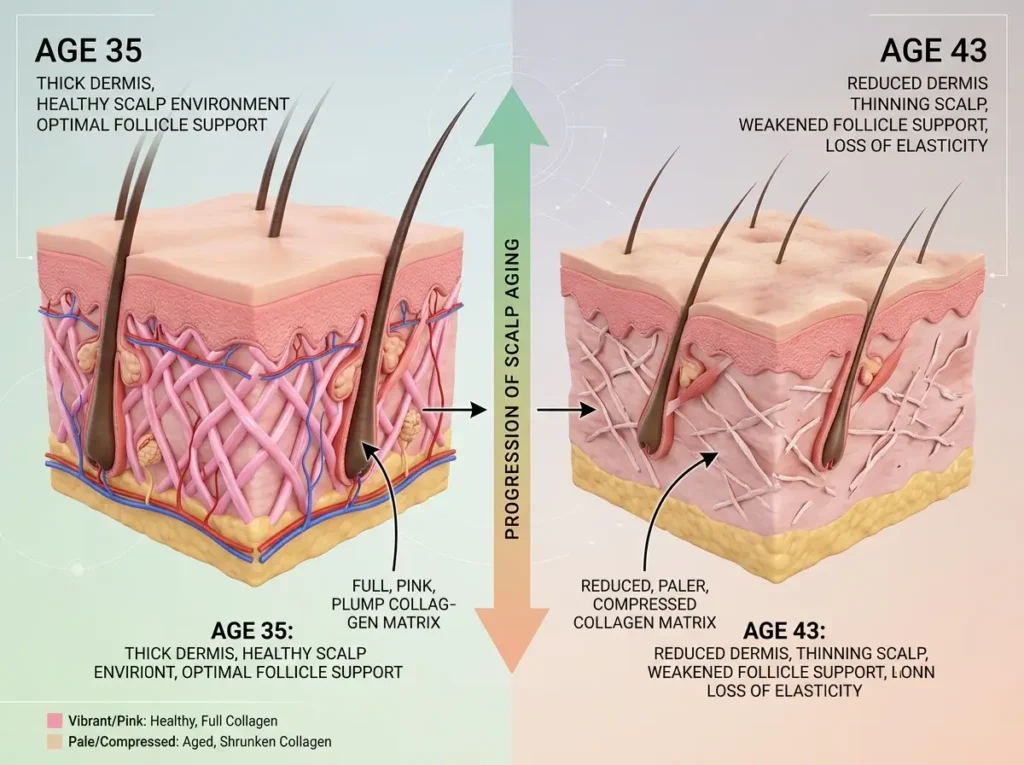
There’s a second mechanism rarely discussed: your scalp is shrinking. Estrogen stimulates collagen production in the dermal layer where follicles anchor. As levels drop during perimenopause, scalp collagen decreases by 1-2% annually after 40. This reduces the physical surface area and blood flow supporting each follicle.
Less collagen means less “padding” and circulation. The follicles don’t just miniaturize—they get squeezed in a tightening environment. This creates the specific “my ponytail feels different” sensation: the hair isn’t just thinner, but the scalp feels tighter when you pull it back.
What This Means: Your scalp is literally tightening. Less cushion means less blood flow to follicles, making the hair that does grow weaker and more brittle.
The Three Stages of Perimenopause Hair Thinning
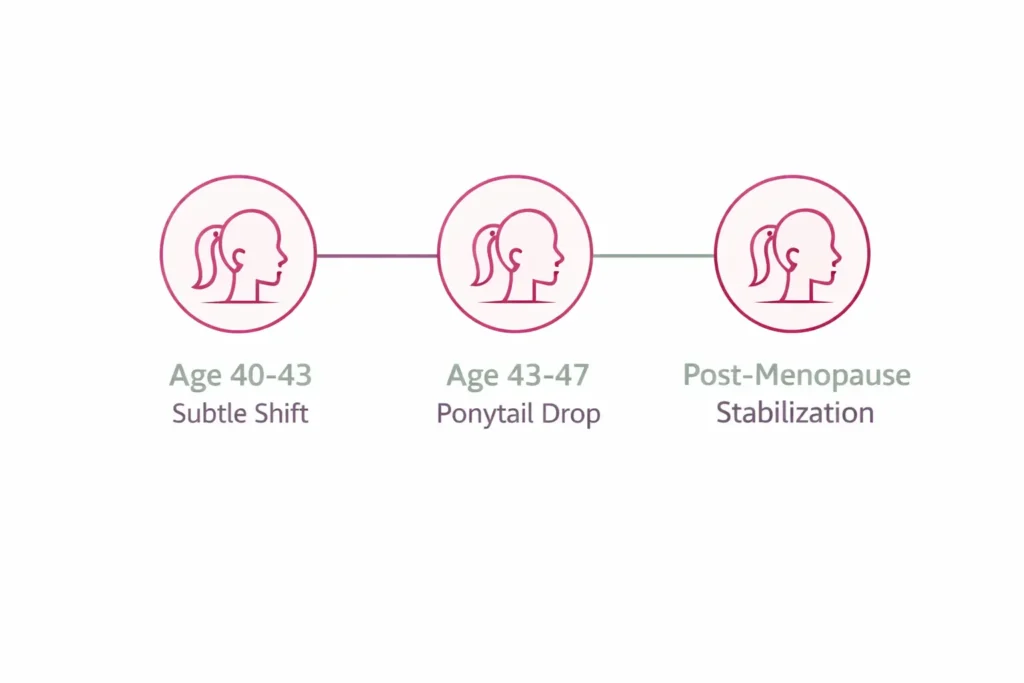
Stage 1: The Subtle Shift (Ages 40-43) You notice more hair in the shower drain, but your ponytail feels mostly normal. This is increased shedding (telogen effluvium) triggered by hormonal fluctuations. The hair tie still wraps twice.
Stage 2: The Ponytail Drop (Ages 43-47) The circumference change becomes tactile. You wrap the tie three times, or you feel the base of the ponytail is “wispier.” This is active miniaturization—DHT has begun permanently shrinking follicles. This stage creates the most anxiety because the change is visible and irreversible without intervention.
Stage 3: Stabilization (Post-Menopause) Once estrogen levels stabilize at a lower baseline (usually 1-2 years after the final period), the thinning stops progressing. Your ponytail doesn’t return to its 35-year-old density, but it stops shrinking. Many women report their hair feels “different but stable” in their early 50s.
When It’s Not Just Perimenopause (Red Flags)
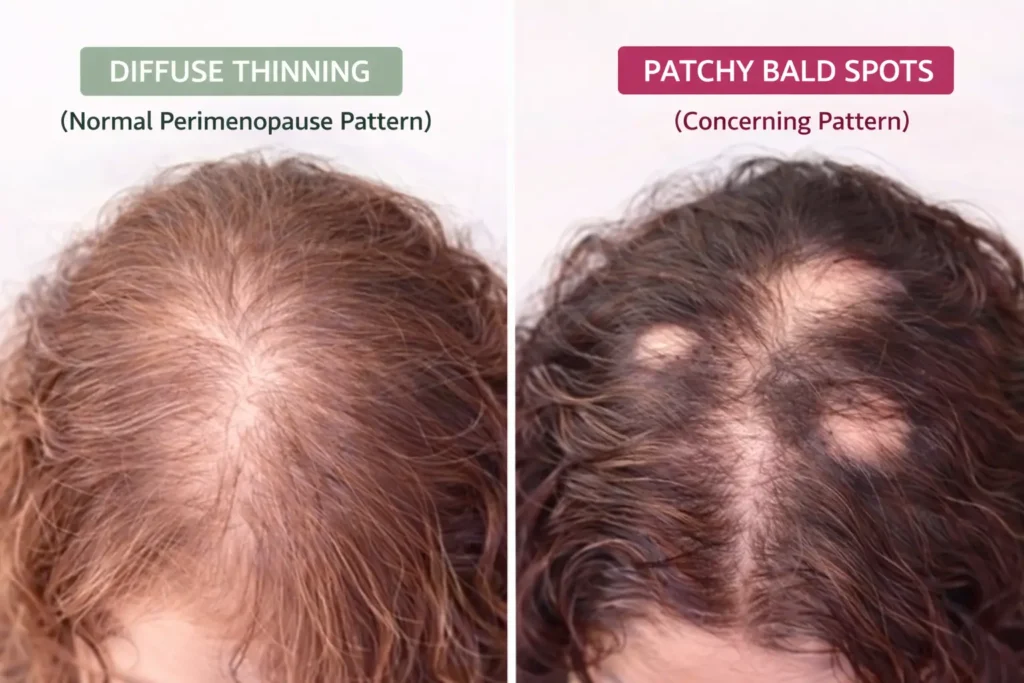
While thinning at 43 is typically hormonal, certain patterns indicate other causes:
- Patchy bald spots: Indicates alopecia areata (autoimmune), not perimenopause
- Scalp pain or burning: Suggests inflammatory conditions like CCCA
- Sudden shedding with fatigue: Could signal thyroid dysfunction (common in this age group)
- Hair breaking, not falling out: Indicates damage, not hormonal thinning
If your ponytail changed overnight (within 3 months) rather than gradually over 1-2 years, see a dermatologist. True perimenopause thinning is gradual; you notice the ponytail difference retrospectively, not overnight.
What You Can Actually Do ?
You cannot stop the hormonal shift—it’s baked into the aging process—but you can influence how severely it manifests:
Cortisol competes with progesterone, accelerating the estrogen decline. High stress at 43 speeds up the hair thinning timeline. Prioritizing sleep and cortisol reduction won’t reverse miniaturization but can prevent premature telogen effluvium (stress shedding) from compounding the hormonal loss.
Hair is keratin—protein. The follicle’s nutrient priority drops during perimenopause as the body redirects resources. Aim for 25-30g protein within 30 minutes of waking to signal “resources available” to hair follicles.
Miniaturized follicles are vulnerable follicles. Avoid tight ponytails (traction alopecia hormonal thinning is irreversible) and keep the scalp clean—sebum buildup further shrinks the follicle opening.
A dermatologist can perform a trichoscopy to confirm miniaturization patterns specific to androgenic thinning versus other causes. Knowledge is validation; validation reduces stress; reduced stress slows additional shedding.
Your ponytail at 43 is a biological marker, not a beauty failure. The circumference change represents a measurable hormonal shift that half of all women experience. Understanding the DHT mechanism, the collagen loss, and the three-stage progression transforms the anxiety of “what’s happening to my hair” into the clarity of “this is the physiological transition I expected.” The hair tie wrapping three times isn’t a crisis—it’s data.
FAQ
Q: Why does my ponytail feel thinner specifically at age 43?
A: Age 43 represents the statistical peak of early perimenopause, when estrogen levels have dropped sufficiently to allow DHT to begin miniaturizing hair follicles, reducing strand diameter and ponytail circumference.
Q: Is my ponytail actually thinner or am I just imagining it?
A: You're not imagining it. Objective measurement shows ponytail circumference decreases 30-50% during perimenopause due to follicle miniaturization. Most women detect this before visible scalp thinning appears.
Q: What's the difference between perimenopause thinning and regular aging?
A: Perimenopause thinning is rapid, diffuse, and hormonally driven (ages 40-50), while general aging hair loss happens gradually over decades (50-70). Perimenopause accelerates thinning to 10-15% per year versus 10% per decade.
Q: Can the ponytail test diagnose hair loss?
A: No, it's a self-monitoring tool, not a diagnosis, but consistent circumference reduction correlates strongly with clinical miniaturization patterns.
Q: Will my hair return to normal after menopause?
A: No, miniaturized follicles don't return to previous size, but thinning stabilizes and shedding decreases significantly post-menopause.
Q: Why does my hair tie wrap more times around my ponytail now?
A: Reduced hair circumference means less resistance against the elastic. If your tie went from 2 wraps to 3-4, you've likely lost 30-40% of ponytail volume.
Q: Is this type of hair loss permanent?
A: The thinning is permanent in that miniaturized follicles don't enlarge, but the progression halts after menopause.
Q: How is perimenopause hair thinning different from male pattern baldness?
A: Women experience diffuse thinning maintaining the hairline; men experience patterned recession and crown balding.
Q: Can stress at 43 make my ponytail thinner faster?
A: Yes. Cortisol spikes accelerate the shift from growth to shedding phases, compounding hormonal thinning.
Q: Should I see a doctor if I notice my ponytail shrinking at 43?
A: Yes, to rule out thyroid issues or autoimmune conditions, though perimenopause is the most likely cause at this age.
Q: Why do I notice the ponytail change before seeing scalp thinning?
A: The ponytail aggregates all hair; diffuse thinning shows in volume loss before scalp visibility. You need to lose ~50% density before scalp shows.
Q: Does this mean I'm going bald?
A: No. Perimenopause causes thinning (reduced density), not balding (complete follicle death). Women rarely go bald from hormonal changes.