



Why Daylight Makes Your Skin Look Different After 35
You catch yourself in the bathroom mirror and everything looks fine. Then you walk outside — or sit near a window — and suddenly every texture, every pore, every uneven patch is visible in a way it wasn’t two minutes ago. It feels jarring. Like your skin changed overnight.
It didn’t change in that moment. After 35, four biological shifts — collagen decline, slower cell turnover, hormonal fluctuation, and a thinning skin barrier — work together to change how your skin’s surface interacts with light. Natural daylight simply has no filter. It shows all of it at once.
Quick Answers
Why does daylight make skin look different after 35? Natural light is unfiltered and hits the face from every angle simultaneously. After 35, changes in skin structure give that light more surface variation to reveal — texture, pores, and tone differences that indoor lighting softens and hides.
What causes skin to look uneven in natural light after 35? Collagen loss reduces skin firmness and smoothness. Slower cell turnover leaves older, duller cells on the surface. Estrogen shifts disrupt pigmentation. A thinning skin barrier reduces moisture and radiance. All four happen at the same time.
Is it normal for skin to look worse in daylight after 35? Yes — extremely common and entirely biological. Most women notice this shift between 35 and 45. It is not caused by the wrong cleanser or failing products. It is driven by hormonal and structural changes in the skin itself.
Does indoor lighting hide skin changes? Yes. Warm indoor lighting comes from one direction and creates soft shadows that minimize texture and tone differences. Natural daylight comes from multiple directions at once with no warmth filter — it removes those shadows entirely.
Does perimenopause affect how skin looks in daylight? Yes. Perimenopause can begin as early as 35 and brings estrogen fluctuations that reduce moisture, affect pigmentation, and accelerate collagen loss — all of which make skin surface changes more visible in natural light.
1. What’s Actually Happening When You Step Into Natural Light

Indoor lighting — lamps, overhead bulbs, bathroom fixtures — typically comes from one direction and casts a warm, even glow. It creates soft shadows that smooth out texture and minimize uneven tone. Natural daylight works completely differently. It is unfiltered and comes from multiple angles simultaneously, landing on every surface of your face at once.
That means it catches the edges of pores, the slight variation in skin texture across different zones, and the way light bounces differently off areas with more or less hydration. It reveals surface variation in a way that a single warm overhead source simply cannot.
After 35, your skin has more of that surface variation than it used to. Daylight is not making your skin look bad. It is showing you exactly what is there.
Short Answer: Natural daylight hits skin from multiple angles with no filter, making texture, pores, and tone differences visible in ways indoor lighting hides. After 35, biological changes give daylight more to show.
2. Your Collagen Is Declining — And Daylight Shows It First
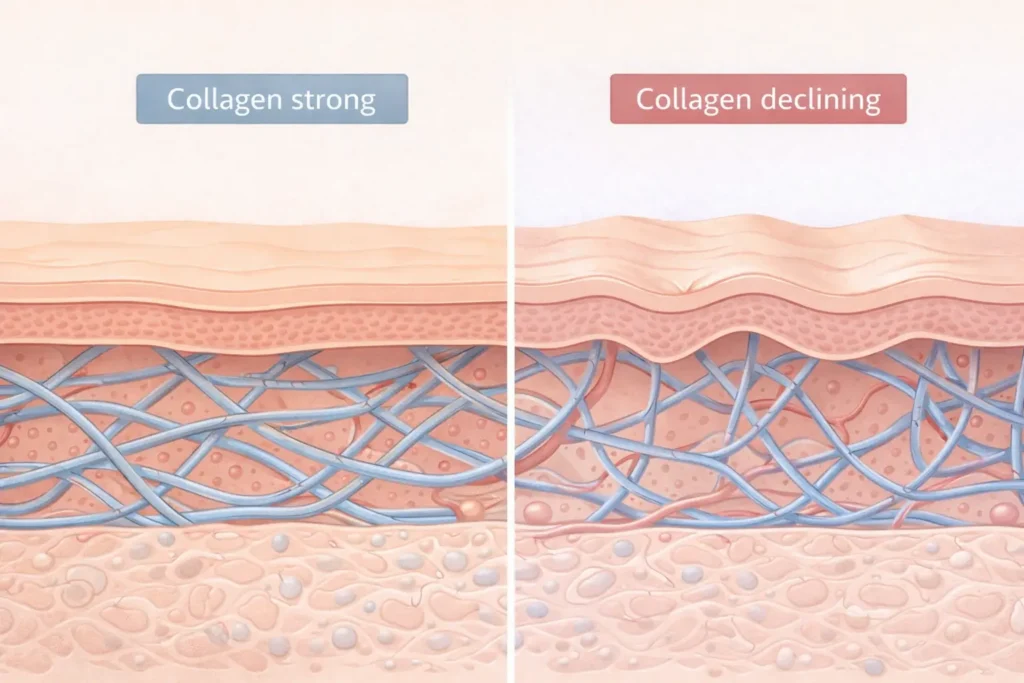
Collagen is the structural protein that keeps skin firm, plump, and smooth. Production begins slowing in your late 20s and accelerates noticeably after 35. At the same time, the collagen already in place breaks down faster than it gets replaced.
What does that look like on your face? Skin becomes slightly thinner. It loses some of its internal scaffolding. The surface shows fine lines, subtle texture shifts, and areas that no longer sit as tautly as they did. In indoor lighting, these changes are easy to miss. In daylight, multi-angle light exposure makes them immediately visible.
Elastin — the protein responsible for skin’s bounce — declines alongside collagen. Together, their loss changes how the skin’s surface scatters light. Younger skin reflects light more evenly because the surface is smoother and more uniform. After 35, that surface has more variation, and daylight shows all of it at once.
Short Answer: Collagen and elastin decline after 35 make skin thinner and less smooth. Daylight exposes this by showing how light scatters unevenly across a less structured surface.
3. Cell Turnover Slows Down After 35 — Here’s What That Looks Like in Sunlight
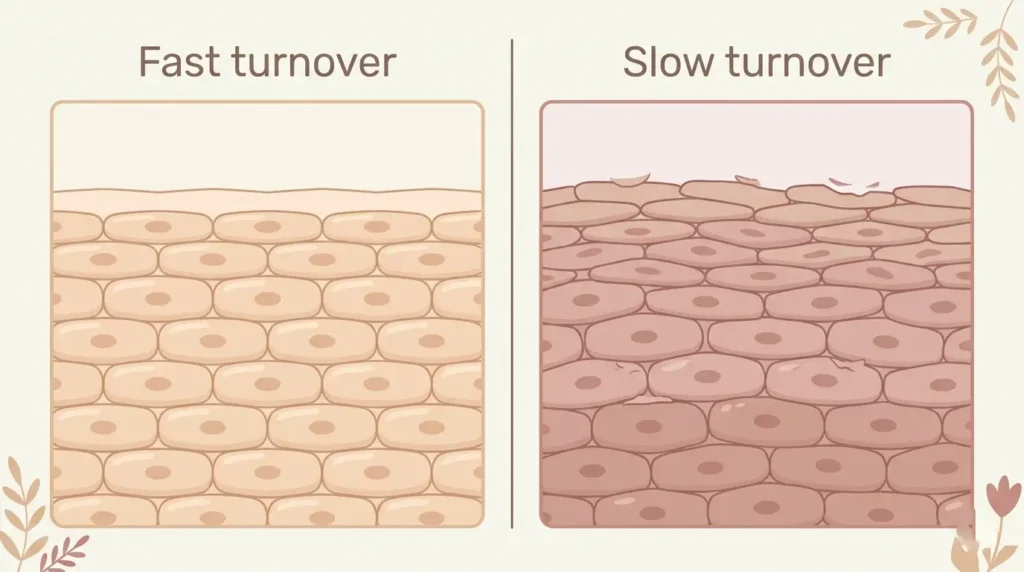
In your 20s, your skin sheds and replaces surface cells roughly every 28 days. After 35, that cycle stretches to 40, 50, or even 60 days. Dead skin cells sit on the surface longer before fresh ones replace them.
The result is a surface that is slightly duller, slightly rougher, and less even in tone. In indoor lighting, this reads as skin that looks a little tired. In natural daylight, it appears clearly — as dullness, as micro-texture, as patches of uneven tone that seem to arrive from nowhere.
This is also why skin can look grayish or flat in bright light. The surface layer is not reflecting light cleanly the way fresh cells do. It is absorbing and scattering it instead.
Short Answer: After 35, skin cells take longer to turn over, leaving a duller, rougher surface. Daylight makes this visible as uneven tone, texture, and reduced radiance.
4. Hormonal Shifts Change How Your Skin Reflects Light
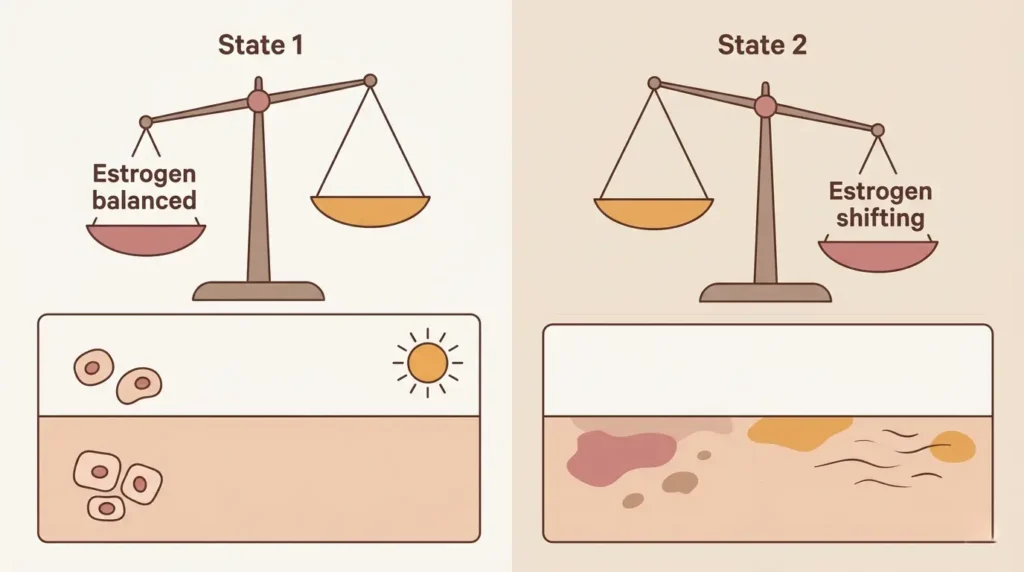
Estrogen plays a direct role in skin health — it supports collagen production, helps skin retain moisture, and keeps surface tone more even. Starting in the mid-30s, estrogen levels begin shifting unpredictably, especially as perimenopause begins.
As estrogen fluctuates, skin loses some of its moisture-retention ability. Melanin production — the pigment responsible for skin color — becomes less regulated, leading to patches of hyperpigmentation, uneven tone, or subtle blotchiness that were not present before.
In daylight, all of this appears simultaneously. Slightly thinner skin, less even pigmentation, and reduced moisture create a surface that reflects light differently across different zones — which shows up as unevenness or dullness depending on the angle.
Short Answer: Estrogen shifts after 35 reduce moisture retention and disrupt melanin regulation, creating uneven tone and texture that natural light makes immediately visible.
5. Your Skin Barrier Is Thinner Now — And That Changes Everything
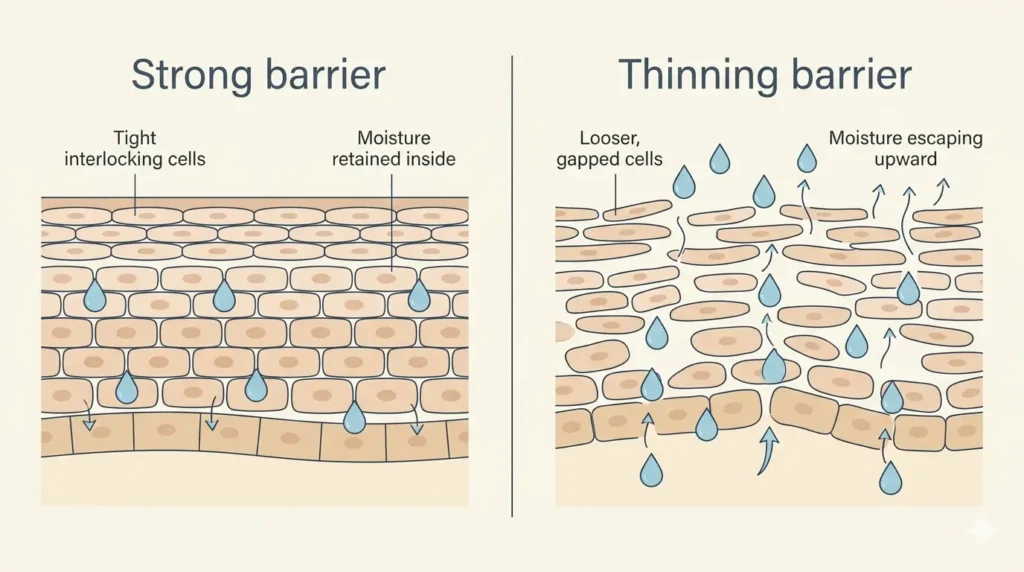
The skin barrier is the outermost layer of your skin. A healthy barrier holds moisture in, keeps irritants out, and reflects light evenly — giving skin that natural, hydrated glow. A weakened barrier does the opposite. It loses water faster, becomes more reactive, and creates a surface that looks flat and dull regardless of how much moisturizer you apply.
After 35, ceramide production — the lipids that hold barrier cells together — slows down. The barrier thins. Skin loses water faster, becomes more sensitive to products it once tolerated easily, and loses its natural luminosity. In daylight, a compromised barrier shows as skin that looks tired, dry at the edges, or strangely flat even when it does not feel dry.
Short Answer: A thinning skin barrier after 35 allows moisture loss and reduces natural radiance. Daylight exposes this as dullness, dryness, or flat-looking skin.
6. Why Indoor Lighting Was Hiding All of This
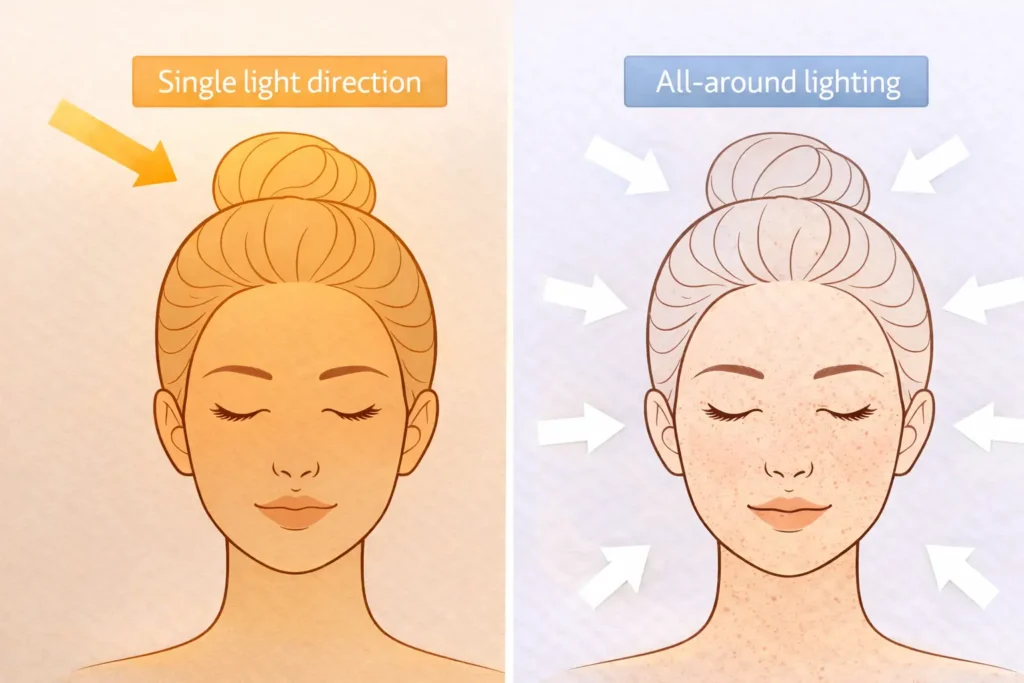
Most indoor lighting is directional and warm-toned. It comes from above or one side, creating soft shadows that smooth texture across the face. The warm amber and yellow tones in standard bulbs minimize the appearance of redness, uneven pigmentation, and fine lines.
Natural daylight is cool, neutral, and multi-directional. It does not create softening shadows. It lands on the entire face evenly at once — so nothing gets hidden. Every slight texture variation, every pore edge, every patch of uneven pigment is lit simultaneously.
This is why the bathroom mirror and the car mirror can look like two entirely different faces. The skin is the same. The light is giving you more complete — and more honest — information about it.
Short Answer: Indoor lighting is warm and directional, which softens texture and hides unevenness. Daylight is neutral and multi-directional — it reveals everything equally.
7. What This Means for How You Think About Your Skin

Understanding why daylight shows more does not make the experience less surprising — but it does change the frame entirely. What you are seeing is not damage or failure. It is biology doing exactly what it does over time.
Collagen loss becomes visually noticeable for most women by the early 40s. Cell turnover slowdown is often detectable on the skin’s surface from the mid-30s onward. Skin barrier thinning tends to accelerate once estrogen begins shifting — which for many women starts between 38 and 45. These changes do not all arrive at once, but they often overlap in the same window — which is exactly why the daylight shift feels sudden even when it has been gradual.
Daylight is an honest light source. Knowing what is actually changing beneath the surface is a far more useful place to start than assuming your moisturizer stopped working.
What This Means: Skin that looks different in daylight after 35 is not broken or aging badly — it is changing in predictable, biological ways with traceable causes and real timelines. The light did not change. Your skin did. And now you know why.
FAQ
Q1: Why does my skin look so much worse in natural light after 35?
Natural light is unfiltered and multi-directional, so it shows texture, pores, and tone differences that indoor lighting softens. After 35, collagen loss, slower cell turnover, hormonal shifts, and a thinning skin barrier all change how your skin's surface reflects light — and daylight reveals all of it simultaneously. Schema: Natural light exposes skin texture and tone changes that occur after 35 due to collagen decline, slower cell turnover, and hormonal shifts — changes that indoor lighting typically softens or hides.
Q2: Is it normal for skin to look different in daylight after 35?
Yes — extremely common and driven entirely by biology. Most women notice this shift between 35 and 45. It is not caused by wrong products or poor skincare habits. It is the result of collagen declining, estrogen fluctuating, and cell turnover slowing — all normal parts of how skin changes with age. Schema: Yes, skin looking visibly different in natural light after 35 is a normal biological change experienced by most women in this age range.
Q3: Why do my pores look so much bigger in sunlight after 35?
Pores do not actually get larger — but the skin around them loses firmness, making them appear more prominent. Collagen and elastin support the structure around each pore. As both decline after 35, that support weakens. In daylight, multi-directional light catches pore edges more clearly than soft indoor lighting does. Schema: Pores appear larger in daylight after 35 because declining collagen and elastin reduce the skin structure around them, and natural light highlights their edges more clearly than indoor lighting.
Q4: Why does my skin look dull in natural light but fine indoors?
Slower cell turnover after 35 leaves older, duller cells on the surface longer. Fresh skin cells reflect light evenly, creating a natural glow. As turnover slows, dead cells accumulate and scatter light unevenly. Warm indoor lighting masks this. Neutral daylight exposes it clearly as dullness or flatness. Schema: Skin looks dull in natural light after 35 because slower cell turnover leaves a less reflective surface that daylight exposes, while warm indoor lighting softens the effect.
Q5: Does estrogen affect how skin looks in natural light?
Yes. Estrogen supports collagen, moisture retention, and even pigmentation — all of which affect how skin reflects light. As estrogen shifts during perimenopause — which can begin in the mid-30s — skin loses moisture and becomes less even in tone. Daylight makes this visible as blotchiness or unevenness across different zones of the face. Schema: Yes, estrogen decline after 35 reduces skin moisture and disrupts pigmentation regulation, making uneven tone and texture more visible in natural daylight.
Q6: Why does my face look uneven in daylight but not in indoor photos or mirrors?
Indoor lighting and most phone cameras apply softening effects that daylight does not. Most indoor environments use warm, directional light that creates flattering shadows. Phone cameras process images to smooth texture. Natural daylight is cool, unfiltered, and hits the face from all angles at once — removing those softening effects entirely and showing the skin's true surface. Schema: Indoor lighting and cameras soften texture with warm tones and processing. Natural daylight is unfiltered and multi-directional, revealing skin surface differences that other light sources minimize.
Q7: What causes skin texture to suddenly look rough after 35?
Slower cell turnover, collagen loss, and a weakening skin barrier all contribute. When skin renews itself less frequently, older cells build up and create micro-texture. The loss of collagen and ceramides means the skin surface is less smooth and less able to hold moisture evenly — both of which make texture more visible in bright light. Schema: Rough skin texture after 35 results from slower cell turnover, collagen decline, and reduced ceramide production — all creating a less smooth, less even surface that natural light makes clearly visible.
Q8: Can anything improve how skin looks in daylight after 35?
Consistent skincare can improve some of what daylight reveals, though the biological shift is real and ongoing. Retinoids and peptides support collagen. Gentle chemical exfoliants accelerate cell turnover. Ceramides and niacinamide repair and strengthen the skin barrier — which directly affects how evenly skin reflects light. Results develop over months, not days, and work best when the routine is built around understanding what is actually changing rather than chasing a fix. Schema: Skincare ingredients that support collagen, cell turnover, and barrier repair can improve how skin appears in natural light after 35, though results develop gradually over time.
Q9: Does perimenopause make skin look worse in daylight?
Yes — perimenopause accelerates several changes that make skin surface differences more visible in natural light. It can begin as early as 35 and brings estrogen fluctuations that affect moisture, pigmentation, and collagen simultaneously. For many women between 38 and 48, this is the period when the daylight difference becomes most noticeable. Schema: Yes, perimenopause accelerates collagen loss, moisture reduction, and pigmentation unevenness — all of which make skin look more visibly changed in natural daylight.
Q10: Why does my skin look fine at night but different during the day?
Evening lighting — lamps, candles, warm overhead bulbs — casts a soft, golden tone that minimizes contrast and smooths what it touches. Skin looks better in that light at any age. Daytime natural light is the opposite: cool, neutral, and multi-directional. The difference is not your skin changing between morning and night. It is two fundamentally different light sources telling you two different amounts of information. Schema: Warm artificial lighting at night flatters skin by softening texture and minimizing contrast. Daylight is cooler and multi-directional, which reveals skin surface changes more clearly regardless of age.